
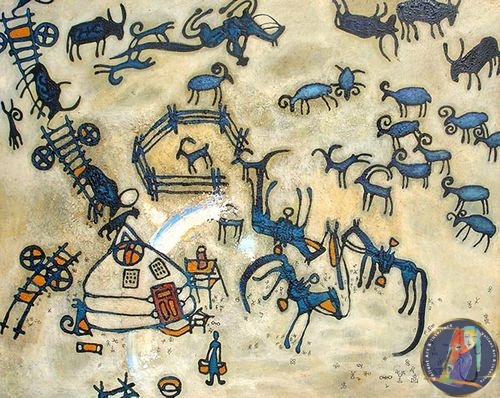
Hometown is a compelling testament to Tsegmid Tserennadmid’s ability to fuse traditional Mongolian sensibilities with a bold, modern aesthetic. Painted in 2006, this oil on canvas serves as a bridge between the artist’s academic mastery and his leanings toward Expressionism and Abstraction.
Visual Composition and Style
Measuring 80 x 100 cm, the work utilizes a generous landscape orientation to capture the expansive spirit of the Mongolian terrain. Rather than a literal architectural rendering of a village, Hometown is an emotional map. Tserennadmid employs thick, energetic brushwork characteristic of his Contemporary Expressionist style, prioritizing the “feeling” of the place over precise anatomical detail.
Color Palette: The artist often utilizes a sophisticated interplay of earthy ochres and deep blues, punctuated by vibrant flashes of color that suggest the shifting light of the steppe.
Abstraction: Elements of the landscape—perhaps the silhouette of a ger (yurt) or the rolling contours of the hills—are distilled into rhythmic shapes and textures. This abstraction reflects his background as an educator and leader in Mongolian fine arts, showing a departure from Soviet-era Realism toward a more personal, liberated visual language.
Cultural and Biographical Context
To understand Hometown, one must consider Tserennadmid’s profound influence on the Mongolian art scene. Born in Ulaanbaatar in 1958, he reached the pinnacle of the academic world, serving as the President of the University of Art & Culture.
This painting was created during a prolific period just before his major international circuit in 2007, which saw his work exhibited in Montreal, Las Vegas, and London. The piece embodies the “Kingdom of the Horse” spirit—a recurring theme in his London exhibitions—where the land is not just a setting, but a living, breathing character tied to nomadic identity.