
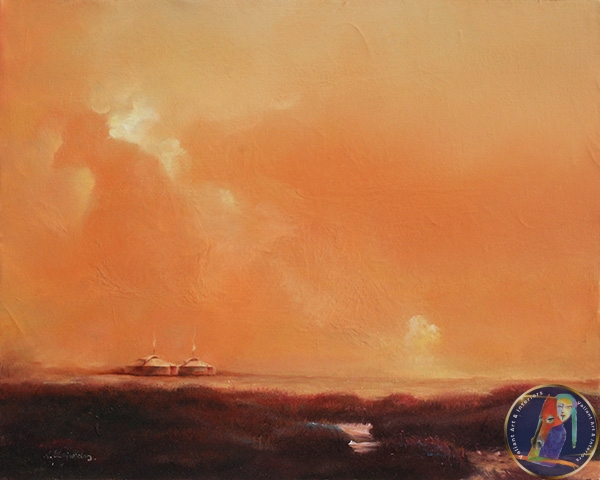
“Hometown” (2009) is a realist, eco-focused figurative landscape that captures the serene, deeply rooted connection between Mongolian nomadic life and the natural environment. The composition centers on a traditional settlement (gail or homestead) nestled into the sweeping expanse of the Mongolian countryside. Adyabaatar constructs the scene with a grounded, intimate perspective, focusing on the quiet, harmonious interrelationship between humans, domestic fauna, and the flora of the steppes.
The foreground and midground feature elements of traditional rural life—likely including livestock such as horses or sheep, and classic felt gers (yurts)—anchoring the human presence as a natural extension of the terrain rather than an interruption to it. The arrangement of the figures and animals emphasizes a slow-paced, seasonal rhythm of daily life, characteristic of the artist’s dedication to preserving pastoral traditions.
Color Palette & Atmospheric Quality
The color palette is dominated by earthy, organic tones that shift with the natural light of the Mongolian sky. Adyabaatar utilizes a soft, texturally rich application of oil paint to render the vast grasslands, employing gradients of weathered ochre, pale greens, and deep browns to mimic the tough, resilient vegetation of the Dund Gobi region.
The atmosphere of the painting is defined by what the artist frequently explores as the “great peacefulness” of her country. The light is diffused and gentle, filtering across the canvas to eliminate harsh shadows and create an overarching sense of stillness and ecological equilibrium.
Style & Technique
Executed with realistic precision, the painting avoids idealized sentimentality in favor of a genuine, grounded depiction of rural reality. The brushwork alternates between broad, soft strokes for the massive sky and rolling hills, and finer, deliberate detailing on the textures of the animals’ coats, the woven structures of the homestead, and the contours of the land. Through this balance, the artwork functions as a piece of “eco-art,” visually documenting the delicate, enduring lifestyle of the Mongolian steppes under an expansive, quiet horizon.