
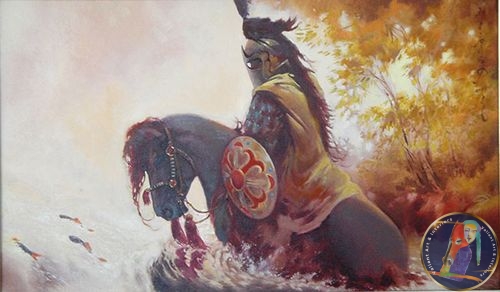
Hero

Olzbaatar Tserendorj , 2005 , Oil On Canvas

In Hero, Olzbaatar Tserendorj leverages the rigorous academic training he received at the Surikov Painting Academy to create a work that feels simultaneously like a historical document and a cinematic still. Measuring 30 x 50cm, this oil-on-canvas piece is a masterclass in the Photorealist and Figurative styles, capturing the rugged essence of Mongolian heritage.

Visual Composition and Subject

The painting features a central figure—a Mongolian warrior or “Hero”—rendered with startling anatomical precision. Tserendorj’s use of light is dramatic yet naturalistic, highlighting the weathered textures of the subject’s traditional attire.

  • The Figure: The “Hero” is depicted with a stoic, weathered expression that suggests a lifetime of endurance. Every wrinkle, the sun-darkened hue of the skin, and the intensity in the eyes are articulated through fine, layered brushwork characteristic of the Russian Realist tradition.

  • The Attire: Great attention is paid to the materiality of the clothing. The viewer can almost feel the weight of the heavy silks, leather, or furs, which are painted with a focus on how light interacts with different surfaces (specular highlights on leather vs. soft absorption on fabric).

  • The Setting: Consistent with Tserendorj’s association with Landscape and Nature, the background is likely a sweeping, atmospheric depiction of the Mongolian steppe. The horizon line is positioned to emphasize the vastness of the land, grounding the figure as a literal and symbolic protector of the terrain.

Style and Technique

The painting serves as a bridge between Classical Realism and modern Photorealism.

  • Color Palette: The artist utilizes an earthy, grounded palette dominated by ochres, deep browns, and slate blues, reflecting the natural colors of the high plateau.

  • Atmosphere: There is a palpable sense of “air” in the painting. Tserendorj uses subtle sfumato (softening of transitions) in the background to create depth, ensuring the figure “pops” with high-contrast clarity in the foreground.
  • Olzbaatar Tserendorj
  • Abstract, Figurative
  • Oil On Canvas
  • OLZ44/001
  • 30 x 50cm
  • Mongolian Art Gallery

Add Your Comment

Mongolian Art Gallery © 2025. All Rights Reserved
Privacy Policy / Terms of Use

In Hero, Olzbaatar Tserendorj leverages the rigorous academic training he received at the Surikov Painting Academy to create a work that feels simultaneously like a historical document and a cinematic still. Measuring 30 x 50cm, this oil-on-canvas piece is a masterclass in the Photorealist and Figurative styles, capturing the rugged essence of Mongolian heritage.

Visual Composition and Subject

The painting features a central figure—a Mongolian warrior or “Hero”—rendered with startling anatomical precision. Tserendorj’s use of light is dramatic yet naturalistic, highlighting the weathered textures of the subject’s traditional attire.

  • The Figure: The “Hero” is depicted with a stoic, weathered expression that suggests a lifetime of endurance. Every wrinkle, the sun-darkened hue of the skin, and the intensity in the eyes are articulated through fine, layered brushwork characteristic of the Russian Realist tradition.

  • The Attire: Great attention is paid to the materiality of the clothing. The viewer can almost feel the weight of the heavy silks, leather, or furs, which are painted with a focus on how light interacts with different surfaces (specular highlights on leather vs. soft absorption on fabric).

  • The Setting: Consistent with Tserendorj’s association with Landscape and Nature, the background is likely a sweeping, atmospheric depiction of the Mongolian steppe. The horizon line is positioned to emphasize the vastness of the land, grounding the figure as a literal and symbolic protector of the terrain.

Style and Technique

The painting serves as a bridge between Classical Realism and modern Photorealism.

  • Color Palette: The artist utilizes an earthy, grounded palette dominated by ochres, deep browns, and slate blues, reflecting the natural colors of the high plateau.

  • Atmosphere: There is a palpable sense of “air” in the painting. Tserendorj uses subtle sfumato (softening of transitions) in the background to create depth, ensuring the figure “pops” with high-contrast clarity in the foreground.