
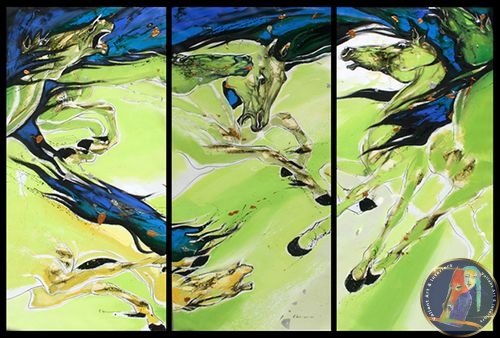
Green Triple Part is a significant oil-on-canvas work by Mongolian artist Enkhtaivan Ochirbat. Measuring 70 x 165 cm, the painting utilizes an elongated horizontal format that emphasizes the vastness inherent in the Mongolian landscape, reimagined through a lens of contemporary abstraction and expressionism.
Visual Composition and Style
The artwork is a masterful blend of Contemporary Figurative Landscape and Expressionism. Rather than a literal depiction of the steppe, Ochirbat uses a triptych-like conceptual structure (alluded to in the title “Triple Part”) contained within a single expansive canvas.
Color Palette: As the title suggests, the work is dominated by a sophisticated range of greens—from deep, mossy emeralds to pale, translucent limes. These are often punctuated by earthy undertones and sudden bursts of contrasting light, reflecting the shifting moods of the Mongolian wilderness.
Brushwork: Ochirbat’s background in the “Action” exhibition series (2002–2004) is evident here. The application of oil paint is rhythmic and energetic. There is a palpable sense of movement, with sweeping horizontal strokes that mimic wind-swept grass or rolling hills, balanced by vertical “fractures” that divide the composition into its three thematic parts.
Abstraction vs. Figuration: While the piece leans heavily into the Abstract Modern style, it remains rooted in the physical world. The “parts” of the painting suggest different perspectives of the same horizon—perhaps representing the passage of time, the changing light of a single day, or the spiritual layers of the land.
Context and Artistry
Created in 2010, this work represents a mature period for Ochirbat, following his international exposure in the United States, Russia, and Europe. His role as an art teacher at the “Industry and Art” school since 2002 provides a technical backbone to the piece; the composition is disciplined despite its expressive freedom.
The painting serves as a bridge between traditional Mongolian reverence for nature and a modern, globalized aesthetic. It does not just show the land; it communicates the feeling of being immersed in it. The large scale (165 cm width) creates an immersive experience for the viewer, inviting them to move their eyes across the “Triple Part” as if scanning a distant, verdant horizon.