
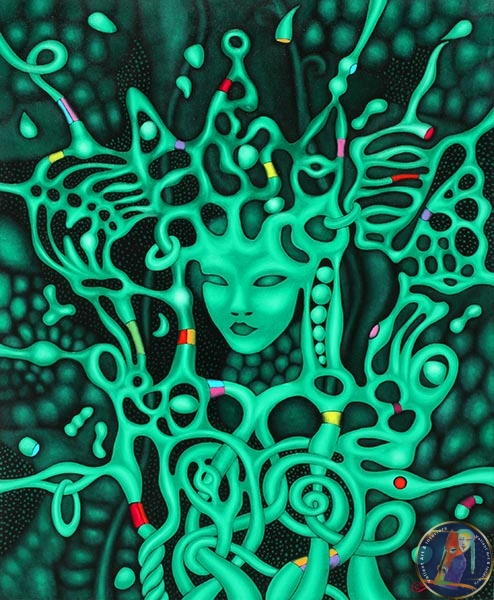
In Green Queen, Oilan Janatkhan presents a striking fusion of contemporary portraiture and abstract expressionism. The painting features a central, regal figure—the “Green Queen”—who emerges from a textured background. The composition is tightly cropped, focusing on the Queen’s upper torso and head, which lends the piece an intimate yet imposing presence.
While the title suggests a royal subject, Janatkhan avoids traditional monarchical tropes. Instead, the “royalty” is conveyed through the subject’s stoic posture and the ethereal, crown-like abstractions that blend into the surrounding space.
Color Palette and Texture
True to its name, the painting is dominated by a sophisticated spectrum of greens, ranging from:
Deep Forest and Emerald: Providing shadows and structural depth.
Sage and Pistachio: Softening the facial features and garments.
Acid Lime Accents: Used sparingly to highlight edges and create a sense of vibrating light.
The application of oil paint is deliberate and heavy. Janatkhan utilizes his expressionist roots to build a rich impasto surface. Visible brushstrokes and palette knife marks create a rhythmic energy, suggesting that the figure is not static, but rather woven into the very fabric of the atmosphere.
Style and Influence
The work serves as a bridge between the artist’s Mongolian heritage and the Western European influences gathered during his extensive travels through France, Germany, and Holland.
Abstract Elements: The background dissolves into non-representational shapes, echoing Janatkhan’s interest in the “still life” of the mind.
Portraiture: Despite the abstraction, there is a hauntingly human element in the eyes and the tilt of the head, capturing a specific psychological state—one of quiet resilience and ancient wisdom.
About the Artist
Oilan Janatkhan (b. 1971, Ulaanbaatar) is a prominent figure in the modern Mongolian art scene. A graduate of the Institute of Fine Art (1991), his work is characterized by a global perspective, refined through a decade of international exhibitions in the 1990s across Pakistan, France, Turkey, and Germany. Green Queen represents the maturity of his style, where the rigid lines of his early education have softened into the fluid, emotive power of contemporary expressionism.