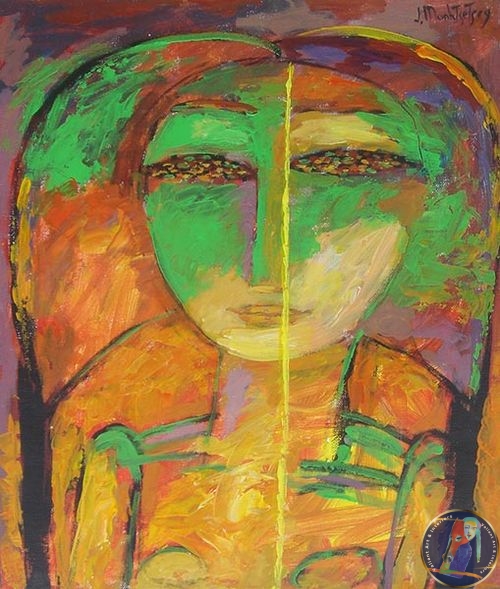
Green Face

Munkhtsetseg Jalkhaajav , 2008 , Oil On Canvas

Green Face is a compelling exploration of the human psyche and the body’s connection to the spiritual realm, rendered in Munkhtsetseg Jalkhaajav’s signature Contemporary Figurative style. Despite its modest dimensions, the painting commands a powerful presence through its concentrated emotional depth and distinct color palette.

Composition and Color

The painting centers on a stylized, enigmatic face that dominates the canvas. As the title suggests, the subject is rendered in varying shades of verdant and earthy greens, subverting traditional skin tones to suggest a symbiotic relationship between the human form and the natural or spirit world.

  • The Palette: The use of green is not merely aesthetic; it evokes themes of healing, rebirth, and perhaps a touch of the “otherworldly.” This is contrasted against a background that utilizes Jalkhaajav’s typical atmospheric layering, creating a sense of shallow, intimate space.

  • The Features: The facial features are simplified—almost mask-like—drawing on the artist’s Mongolian heritage and her interest in the internal “energy” of the female form. The eyes often serve as the focal point, reflecting a quiet, meditative intensity that borders on the melancholic.

Style and Technique

Jalkhaajav’s Russian academic training in Minsk is evident in the confident handling of the oil medium, yet she breaks away from traditional realism toward Abstract Modernism.

  • Texture: The brushwork is deliberate, balancing smooth transitions with areas of visceral texture that suggest the fragility of skin or the weight of thought.

  • Symbolism: In line with her broader body of work, Green Face likely touches upon the concept of “metamorphosis.” The face feels as though it is in a state of transition—not quite human, yet deeply relatable. It mirrors her fascination with the “inner world” and the healing powers often attributed to feminine energy in Mongolian culture.
  • Munkhtsetseg Jalkhaajav
  • Abstract, Calligraphy, Figurative
  • Oil On Canvas
  • MUK37/027
  • 30 x 40 cm
  • Mongolian Art Gallery

Add Your Comment

Mongolian Art Gallery © 2025. All Rights Reserved
Privacy Policy / Terms of Use

Green Face is a compelling exploration of the human psyche and the body’s connection to the spiritual realm, rendered in Munkhtsetseg Jalkhaajav’s signature Contemporary Figurative style. Despite its modest dimensions, the painting commands a powerful presence through its concentrated emotional depth and distinct color palette.

Composition and Color

The painting centers on a stylized, enigmatic face that dominates the canvas. As the title suggests, the subject is rendered in varying shades of verdant and earthy greens, subverting traditional skin tones to suggest a symbiotic relationship between the human form and the natural or spirit world.

  • The Palette: The use of green is not merely aesthetic; it evokes themes of healing, rebirth, and perhaps a touch of the “otherworldly.” This is contrasted against a background that utilizes Jalkhaajav’s typical atmospheric layering, creating a sense of shallow, intimate space.

  • The Features: The facial features are simplified—almost mask-like—drawing on the artist’s Mongolian heritage and her interest in the internal “energy” of the female form. The eyes often serve as the focal point, reflecting a quiet, meditative intensity that borders on the melancholic.

Style and Technique

Jalkhaajav’s Russian academic training in Minsk is evident in the confident handling of the oil medium, yet she breaks away from traditional realism toward Abstract Modernism.

  • Texture: The brushwork is deliberate, balancing smooth transitions with areas of visceral texture that suggest the fragility of skin or the weight of thought.

  • Symbolism: In line with her broader body of work, Green Face likely touches upon the concept of “metamorphosis.” The face feels as though it is in a state of transition—not quite human, yet deeply relatable. It mirrors her fascination with the “inner world” and the healing powers often attributed to feminine energy in Mongolian culture.