
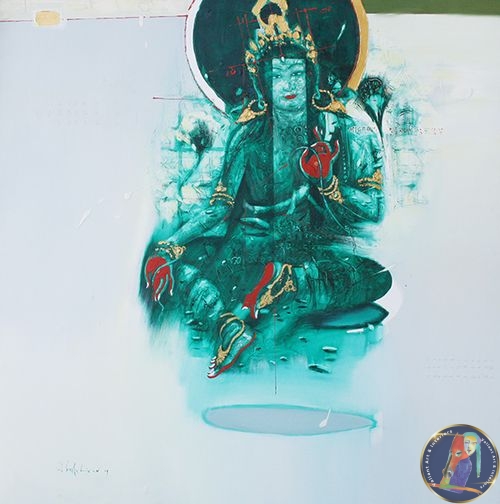
Green Buddha

Enkhtaivan Ochirbat , 2009 , Oil On Canvas

Enkhtaivan Ochirbat’s “Green Buddha” (2009) is a powerful synthesis of traditional spiritual iconography and contemporary Mongolian expressionism. Executed in oil on a large-format square canvas ($150 \times 150\text{cm}$), the work dominates the viewer’s field of vision, reflecting the artist’s background in both formal institute training and his lived experience in Ulaanbaatar.

Composition and Form

The painting centers on the monumental figure of the Buddha, rendered with a heavy emphasis on Contemporary Figurative Expressionism. Rather than the rigid, proportional precision found in traditional thangka painting, Ochirbat employs a more fluid, abstract approach. The silhouette of the Buddha is grounded and expansive, filling the frame to suggest a presence that is both physical and ethereal.

Color Palette and Texture

As the title suggests, the work is a study in monochromatic and analogous green tones.

  • The Palette: Ochirbat utilizes a spectrum ranging from deep, mossy forest greens to vibrant, electric malachite. These greens are punctuated by earthy undertones, grounding the spiritual subject in the natural world—a nod to the artist’s “Expressionist Landscape” sensibilities.

  • The Technique: The oil paint is applied with visible, energetic brushwork. The texture is tactile and layered, creating a sense of ancient weathering, as if the image were emerging from an emerald-colored stone or a dense, mist-filled forest.

Style and Symbolism

The painting sits at the intersection of Ochirbat’s varied influences:

  • Abstract Modernism: The features of the Buddha are often deconstructed or softened. The face may be suggested through shifts in light and shadow rather than hard lines, inviting the viewer into a meditative state of interpretation.

  • Cultural Synthesis: Created during his tenure as an art teacher at the “Industry and Art” school, the piece reflects a sophisticated understanding of Mongolian heritage. The green hue specifically evokes the “Green Tara” or the concept of the “Amoghasiddhi Buddha,” symbolizing fearlessness, action, and the harmony of nature.

  • Atmospheric Depth: There is a luminous quality to the work. The central figure seems to radiate a cool, internal light, contrasting with the darker, more chaotic brushstrokes in the periphery of the canvas.
  • Enkhtaivan Ochirbat
  • Geometric, Minimalist, Sculpture
  • Oil On Canvas
  • ENT21/040
  • 150 x 150cm
  • Mongolian Art Gallery

Add Your Comment

Mongolian Art Gallery © 2025. All Rights Reserved
Privacy Policy / Terms of Use

Enkhtaivan Ochirbat’s “Green Buddha” (2009) is a powerful synthesis of traditional spiritual iconography and contemporary Mongolian expressionism. Executed in oil on a large-format square canvas ($150 \times 150\text{cm}$), the work dominates the viewer’s field of vision, reflecting the artist’s background in both formal institute training and his lived experience in Ulaanbaatar.

Composition and Form

The painting centers on the monumental figure of the Buddha, rendered with a heavy emphasis on Contemporary Figurative Expressionism. Rather than the rigid, proportional precision found in traditional thangka painting, Ochirbat employs a more fluid, abstract approach. The silhouette of the Buddha is grounded and expansive, filling the frame to suggest a presence that is both physical and ethereal.

Color Palette and Texture

As the title suggests, the work is a study in monochromatic and analogous green tones.

  • The Palette: Ochirbat utilizes a spectrum ranging from deep, mossy forest greens to vibrant, electric malachite. These greens are punctuated by earthy undertones, grounding the spiritual subject in the natural world—a nod to the artist’s “Expressionist Landscape” sensibilities.

  • The Technique: The oil paint is applied with visible, energetic brushwork. The texture is tactile and layered, creating a sense of ancient weathering, as if the image were emerging from an emerald-colored stone or a dense, mist-filled forest.

Style and Symbolism

The painting sits at the intersection of Ochirbat’s varied influences:

  • Abstract Modernism: The features of the Buddha are often deconstructed or softened. The face may be suggested through shifts in light and shadow rather than hard lines, inviting the viewer into a meditative state of interpretation.

  • Cultural Synthesis: Created during his tenure as an art teacher at the “Industry and Art” school, the piece reflects a sophisticated understanding of Mongolian heritage. The green hue specifically evokes the “Green Tara” or the concept of the “Amoghasiddhi Buddha,” symbolizing fearlessness, action, and the harmony of nature.

  • Atmospheric Depth: There is a luminous quality to the work. The central figure seems to radiate a cool, internal light, contrasting with the darker, more chaotic brushstrokes in the periphery of the canvas.