
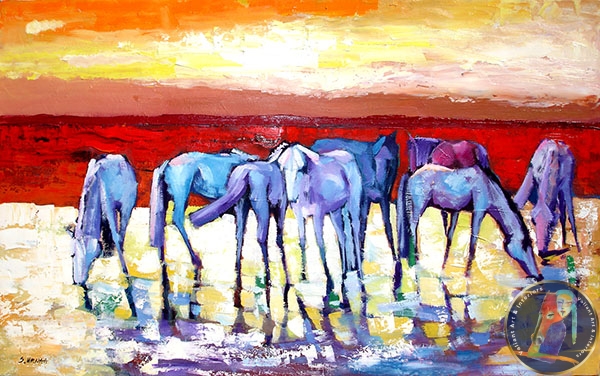
The painting is structured around a wide, horizontal format ($49.8 \times 76.6\text{ cm}$) that mirrors the expansive, panoramic quality of the Mongolian wilderness. The composition is split by a low-slung, sweeping horizon line that emphasizes the vastness of the sky above and the immense depth of the desert floor below.
The structural weight of the canvas rests on a series of undulating, organic lines that form the rolling topography of the Gobi desert. The foreground opens up with broad, sweeping brushstrokes that define shifting sand dunes and arid terrain, leading the viewer’s eye sequentially back toward a deeply receded background.
Color Palette and Light Dynamics
Sodnom uses a rich, evocative color palette heavily anchored in earth tones to capture the unique atmospheric conditions of the Gobi.
The Terrain: The lower half of the canvas is dominated by warm ochres, deep ambers, siennas, and soft terracotta pigments. These shades blend seamlessly into lighter, sun-bleached yellows and cream tones along the crests of the sand dunes, simulating the harsh glare of direct sunlight hitting the desert landscape.
The Atmosphere: Transitioning toward the horizon, the warmth of the earth meets cooler, atmospheric tones. The sky is rendered with an intentionally blended gradient of pale cerulean blue, soft lavenders, and misty ivory whites, capturing the parched, dusty haze that frequently hangs over the desert plains.
Contrast: Subtle, deep brown and muted umber shadows tuck beneath the ridges of the landforms, providing three-dimensional volume, texture, and a sense of geological age to the environment.
Texture, Brushwork, and Style
Executed in oil on canvas, the painting showcases a masterful balance between smooth blending and visible, textured impasto.
The sky and distant mountain horizons features soft, atmospheric blending, where brush edges disappear to evoke continuous space.
In contrast, the desert floor displays a highly tactile quality. The artist uses layered, expressive brushwork to suggest the coarse texture of shifting sands, parched earth, and scattered desert scrub.
The stylistic approach bridges traditional Mongolian semi-realistic landscape representation with an impressionistic focus on light, capturing not just the physical layout of the Gobi, but its immense isolation, quietude, and spiritual grandeur.