Ger

Tsogzol Purev , 2008 , Oil On Canvas

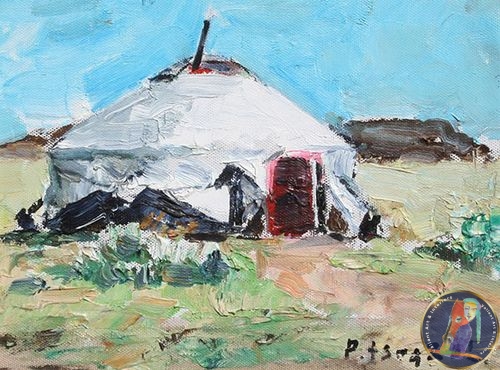
Ger is a masterful 2008 oil painting by the renowned Mongolian artist Tsogzol Purev. It serves as a profound testament to his lifelong dedication to Realism and his deep-rooted connection to the Mongolian landscape. Given Purev’s extensive background as a general art painter for Mongol Kino, the composition carries a cinematic quality, treating the vast steppe not just as a backdrop, but as a living protagonist.


Visual Composition and Subject Matter

The painting centers on the Ger (a traditional Mongolian portable dwelling), which stands as a symbol of nomadic resilience and domestic warmth.

  • The Focal Point: The Ger is rendered with meticulous detail, capturing the texture of the white felt coverings and the structural integrity of the wooden frames and ropes. Its rounded form creates a soft contrast against the jagged or sprawling horizons typical of the Dornod region.

  • The Landscape: As a master of landscape, Purev utilizes a sophisticated palette to depict the Mongolian plateau. The “Nature” style mentioned in his biography is evident here; the grass is not a uniform green but a complex weave of ochres, siennas, and muted golds, suggesting the transition of seasons or the harsh light of high altitude.

  • Atmospheric Perspective: Drawing from his training at the Federal Movie Art Institute in Moscow, Purev employs expert light and shadow. There is a palpable sense of air and distance—the sky likely dominates a significant portion of the canvas, rendered with broad, confident brushstrokes that suggest the “Eternal Blue Sky” of Mongolia.


Artistic Style and Technique

The influence of Purev’s mentors—both Mongolian masters like O. Tsevegjav and Russian realists like F.S. Vodorodskii—is clear in the work’s technical execution:

  • Academic Realism: The painting avoids abstraction. Instead, it leans into a grounded, tangible reality where the weight of the Ger and the vastness of the earth are felt by the viewer.

  • Cinematic Eye: His decades of experience designing over 30 films are reflected in the spatial arrangement. The placement of the Ger often follows the “rule of thirds,” creating a balanced yet dynamic narrative flow that leads the eye from the foreground dwelling out toward the infinite horizon.

  • Texture and Light: The oil medium is used to build layers of depth. One can almost feel the crispness of the air and the stillness of the steppe. The lighting is naturalistic, likely capturing the “golden hour”—a favorite for artists trained in cinematography—which casts long, soft shadows and bathes the scene in a nostalgic, timeless glow.
  • Tsogzol Purev
  • Abstract, Figurative, Geometric
  • Oil On Canvas
  • TSO/002
  • Not Available
  • Mongolian Art Gallery

Add Your Comment

Mongolian Art Gallery © 2025. All Rights Reserved
Privacy Policy / Terms of Use

Ger is a masterful 2008 oil painting by the renowned Mongolian artist Tsogzol Purev. It serves as a profound testament to his lifelong dedication to Realism and his deep-rooted connection to the Mongolian landscape. Given Purev’s extensive background as a general art painter for Mongol Kino, the composition carries a cinematic quality, treating the vast steppe not just as a backdrop, but as a living protagonist.


Visual Composition and Subject Matter

The painting centers on the Ger (a traditional Mongolian portable dwelling), which stands as a symbol of nomadic resilience and domestic warmth.

  • The Focal Point: The Ger is rendered with meticulous detail, capturing the texture of the white felt coverings and the structural integrity of the wooden frames and ropes. Its rounded form creates a soft contrast against the jagged or sprawling horizons typical of the Dornod region.

  • The Landscape: As a master of landscape, Purev utilizes a sophisticated palette to depict the Mongolian plateau. The “Nature” style mentioned in his biography is evident here; the grass is not a uniform green but a complex weave of ochres, siennas, and muted golds, suggesting the transition of seasons or the harsh light of high altitude.

  • Atmospheric Perspective: Drawing from his training at the Federal Movie Art Institute in Moscow, Purev employs expert light and shadow. There is a palpable sense of air and distance—the sky likely dominates a significant portion of the canvas, rendered with broad, confident brushstrokes that suggest the “Eternal Blue Sky” of Mongolia.


Artistic Style and Technique

The influence of Purev’s mentors—both Mongolian masters like O. Tsevegjav and Russian realists like F.S. Vodorodskii—is clear in the work’s technical execution:

  • Academic Realism: The painting avoids abstraction. Instead, it leans into a grounded, tangible reality where the weight of the Ger and the vastness of the earth are felt by the viewer.

  • Cinematic Eye: His decades of experience designing over 30 films are reflected in the spatial arrangement. The placement of the Ger often follows the “rule of thirds,” creating a balanced yet dynamic narrative flow that leads the eye from the foreground dwelling out toward the infinite horizon.

  • Texture and Light: The oil medium is used to build layers of depth. One can almost feel the crispness of the air and the stillness of the steppe. The lighting is naturalistic, likely capturing the “golden hour”—a favorite for artists trained in cinematography—which casts long, soft shadows and bathes the scene in a nostalgic, timeless glow.