Funny Caravan

Tsegmid Tserennadmid , 2008 , Oil On Canvas

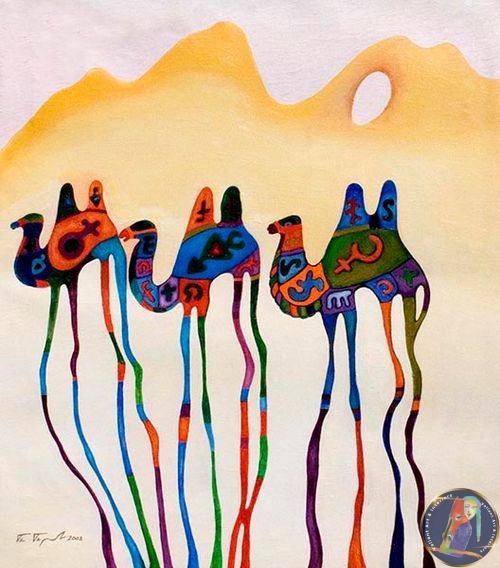
In his 2008 oil-on-canvas work, Funny Caravan, Tsegmid Tserennadmid synthesizes his deep Mongolian roots with a sophisticated contemporary aesthetic. The painting serves as a vibrant bridge between the traditional nomadic lifestyle of Central Asia and the expressive freedom of modern abstraction.

Visual Composition and Style

True to Tsegmid’s background in Expressionism and Modernism, the painting eschews rigid realism in favor of rhythmic movement and emotional resonance. The “caravan”—traditionally a somber, grueling necessity of nomadic life—is reimagined here through a lens of playfulness and kinetic energy.

  • Color Palette: The work typically employs a rich, earthy foundation punctuated by vivid, saturated bursts of color. Deep ochres and sky blues are often met with “funny” or unexpected hits of crimson and yellow, suggesting a celebratory atmosphere rather than a weary trek.

  • Form and Line: Tsegmid utilizes fluid, almost calligraphic brushwork to outline the camels and figures. Their forms are elongated and slightly distorted, creating a sense of “bouncing” or swaying movement that justifies the title’s whimsical nature.

  • Space: The landscape is treated with an Abstract-Expressionist sensibility. Rather than a clear horizon line, the background and foreground often bleed into one another, suggesting the vast, borderless expanse of the Mongolian steppe where time and distance feel fluid.


Symbolic Context

As a former President of the University of Art & Culture in Ulaanbaatar, Tsegmid’s work is intellectually layered. In Funny Caravan, he reclaims the cultural icon of the camel caravan:

  • The Camel: A symbol of endurance and Mongolian identity, here transformed into a vessel of humor and lightness.

  • Modernity vs. Tradition: By applying contemporary abstract techniques to a primitive subject, Tsegmid suggests that Mongolian culture is not a static relic of the past, but a living, breathing, and evolving entity.


Artistic Significance

Created during a period when Tsegmid was gaining significant international traction—following his 2007 exhibitions in Montreal, Las Vegas, and London—this painting represents the artist at the height of his stylistic synthesis. It captures the “Kingdom of the Horse” (and camel) spirit through a lens that is accessible to the global avant-garde while remaining fiercely loyal to the Mongolian soul.
 

  • Tsegmid Tserennadmid
  • Abstract, Modern/Contemporary
  • Oil On Canvas
  • TSG48/031
  • Not Available
  • Mongolian Art Gallery

Add Your Comment

Mongolian Art Gallery © 2025. All Rights Reserved
Privacy Policy / Terms of Use

In his 2008 oil-on-canvas work, Funny Caravan, Tsegmid Tserennadmid synthesizes his deep Mongolian roots with a sophisticated contemporary aesthetic. The painting serves as a vibrant bridge between the traditional nomadic lifestyle of Central Asia and the expressive freedom of modern abstraction.

Visual Composition and Style

True to Tsegmid’s background in Expressionism and Modernism, the painting eschews rigid realism in favor of rhythmic movement and emotional resonance. The “caravan”—traditionally a somber, grueling necessity of nomadic life—is reimagined here through a lens of playfulness and kinetic energy.

  • Color Palette: The work typically employs a rich, earthy foundation punctuated by vivid, saturated bursts of color. Deep ochres and sky blues are often met with “funny” or unexpected hits of crimson and yellow, suggesting a celebratory atmosphere rather than a weary trek.

  • Form and Line: Tsegmid utilizes fluid, almost calligraphic brushwork to outline the camels and figures. Their forms are elongated and slightly distorted, creating a sense of “bouncing” or swaying movement that justifies the title’s whimsical nature.

  • Space: The landscape is treated with an Abstract-Expressionist sensibility. Rather than a clear horizon line, the background and foreground often bleed into one another, suggesting the vast, borderless expanse of the Mongolian steppe where time and distance feel fluid.


Symbolic Context

As a former President of the University of Art & Culture in Ulaanbaatar, Tsegmid’s work is intellectually layered. In Funny Caravan, he reclaims the cultural icon of the camel caravan:

  • The Camel: A symbol of endurance and Mongolian identity, here transformed into a vessel of humor and lightness.

  • Modernity vs. Tradition: By applying contemporary abstract techniques to a primitive subject, Tsegmid suggests that Mongolian culture is not a static relic of the past, but a living, breathing, and evolving entity.


Artistic Significance

Created during a period when Tsegmid was gaining significant international traction—following his 2007 exhibitions in Montreal, Las Vegas, and London—this painting represents the artist at the height of his stylistic synthesis. It captures the “Kingdom of the Horse” (and camel) spirit through a lens that is accessible to the global avant-garde while remaining fiercely loyal to the Mongolian soul.