
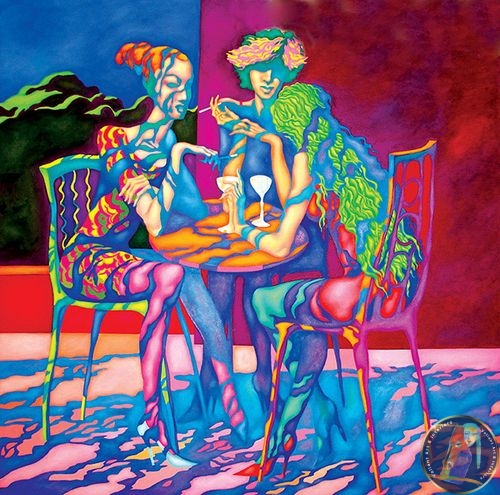
Friends

Enkhjargal Tsagaandari , 2006 , Oil On Canvas

The painting “Friends” (2006) by Mongolian artist Enkhjargal Tsagaandari is a striking example of contemporary Mongolian figurative abstraction. Measuring a substantial 150 x 150 cm, the square format creates a sense of equilibrium and focused intimacy, characteristic of Tsagaandari’s mature freelance period.

Executed in oil on canvas, the work reflects the artist’s deep connection to the cultural and natural heritage of Mongolia, filtered through a modern, stylized lens.

Visual Composition and Style

The painting likely employs a blend of figurative elements and abstract backgrounds, a hallmark of Tsagaandari’s style. Given the title “Friends,” the composition centers on the relationship between its subjects—often depicted as stylized human figures, animals (such as horses, which are central to Mongolian identity), or a symbolic union of the two.

  • Color Palette: Tsagaandari is known for a sophisticated use of color that bridges the gap between traditional Mongolian pigments and modern expressive tones. Expect a rich interplay of earth tones—ochres, deep reds, and siennas—contrasted with vibrant blues or ethereal washes that suggest the vast Mongolian sky or the spiritual “Eternal Blue Heaven.”

  • Form and Line: The figures are likely rendered with a degree of modernist simplification. Rather than strict realism, the artist uses flowing, rhythmic lines to connect the subjects, emphasizing a bond that is spiritual and emotional rather than merely physical.

  • Texture: The oil medium is often applied with a mix of smooth glazes and more textured, energetic brushwork in the background, creating a “landscape” that feels both topographical and psychological.

Symbolic Meaning

In the context of Tsagaandari’s background and the year 2006, “Friends” represents a synthesis of his diverse experiences—from his early days in the Military Institute to his academic tenure at the College of Fine Art.

The work moves beyond a simple portrait; it acts as a meditation on companionship and the communal spirit of nomadic culture. The “Abstract-Nature” style mentioned in his profile suggests that the “Friends” may even be integrated into their environment, implying that friendship is a force of nature itself, as enduring and expansive as the steppes.

Artistic Context

As a freelance artist since 2000, Tsagaandari used this period to move away from the rigid monumentalism of his early career toward a more personal, poetic expression. “Friends” stands as a testament to this evolution, showcasing a master who can command a large-scale canvas to convey a quiet, profound human (or inter-species) connection.

  • Enkhjargal Tsagaandari
  • Calligraphy, Minimalist
  • Oil On Canvas
  • ENJ25/037
  • 150 x 150cm
  • Mongolian Art Gallery

Add Your Comment

Mongolian Art Gallery © 2025. All Rights Reserved
Privacy Policy / Terms of Use

The painting “Friends” (2006) by Mongolian artist Enkhjargal Tsagaandari is a striking example of contemporary Mongolian figurative abstraction. Measuring a substantial 150 x 150 cm, the square format creates a sense of equilibrium and focused intimacy, characteristic of Tsagaandari’s mature freelance period.

Executed in oil on canvas, the work reflects the artist’s deep connection to the cultural and natural heritage of Mongolia, filtered through a modern, stylized lens.

Visual Composition and Style

The painting likely employs a blend of figurative elements and abstract backgrounds, a hallmark of Tsagaandari’s style. Given the title “Friends,” the composition centers on the relationship between its subjects—often depicted as stylized human figures, animals (such as horses, which are central to Mongolian identity), or a symbolic union of the two.

  • Color Palette: Tsagaandari is known for a sophisticated use of color that bridges the gap between traditional Mongolian pigments and modern expressive tones. Expect a rich interplay of earth tones—ochres, deep reds, and siennas—contrasted with vibrant blues or ethereal washes that suggest the vast Mongolian sky or the spiritual “Eternal Blue Heaven.”

  • Form and Line: The figures are likely rendered with a degree of modernist simplification. Rather than strict realism, the artist uses flowing, rhythmic lines to connect the subjects, emphasizing a bond that is spiritual and emotional rather than merely physical.

  • Texture: The oil medium is often applied with a mix of smooth glazes and more textured, energetic brushwork in the background, creating a “landscape” that feels both topographical and psychological.

Symbolic Meaning

In the context of Tsagaandari’s background and the year 2006, “Friends” represents a synthesis of his diverse experiences—from his early days in the Military Institute to his academic tenure at the College of Fine Art.

The work moves beyond a simple portrait; it acts as a meditation on companionship and the communal spirit of nomadic culture. The “Abstract-Nature” style mentioned in his profile suggests that the “Friends” may even be integrated into their environment, implying that friendship is a force of nature itself, as enduring and expansive as the steppes.

Artistic Context

As a freelance artist since 2000, Tsagaandari used this period to move away from the rigid monumentalism of his early career toward a more personal, poetic expression. “Friends” stands as a testament to this evolution, showcasing a master who can command a large-scale canvas to convey a quiet, profound human (or inter-species) connection.