

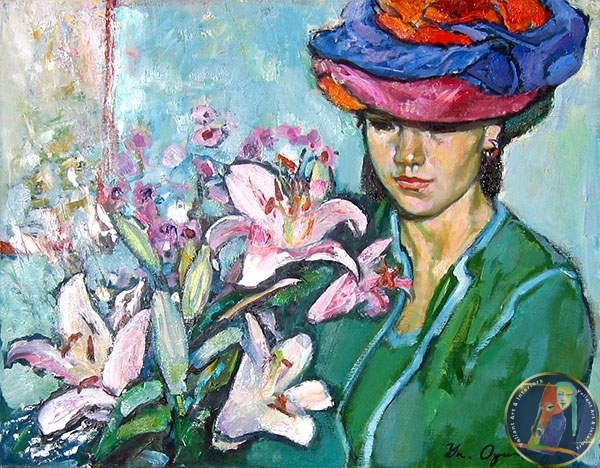
Flowered Girl is a compelling oil portrait that showcases Oyunchimeg Yadamsuren’s mastery of form, blending her rigorous academic training from the Repin Academy with a distinctly Mongolian sensibility. The painting captures a young woman in a moment of quiet introspection, enveloped by a lush, stylized floral environment.
Composition and Subject Matter
The composition is an intimate, medium-close-up study of a female figure. The “Girl” of the title is positioned centrally, her features rendered with a delicate realism that highlights the artist’s technical proficiency in portraiture.
The Figure: The subject possesses a serene, almost statuesque quality. Her gaze is soft and directed slightly away from the viewer, suggesting a private, internal world.
The Floral Motif: Surrounding and perhaps even adorning the figure are vibrant, textured flowers. These are not merely decorative background elements but seem integrated into the subject’s space, creating a harmony between the human form and the natural world.
Color Palette: The artist utilizes a rich, nuanced palette. Deep, earthy tones often found in traditional Mongolian aesthetics are likely balanced by the bright, expressive hues of the blossoms, creating a visual dialogue between grounded reality and ephemeral beauty.
Style and Technique
Yadamsuren’s technique reflects a sophisticated bridge between Russian Social Realism (honed in St. Petersburg) and Mongolian Zurag influences.
Brushwork: The oil application is deliberate and confident. Soft, blended skin tones contrast with more textured, impasto strokes used to define the petals and foliage.
Lighting: There is a gentle luminosity to the piece, with light falling softly across the subject’s face, providing a sense of three-dimensional volume and psychological depth.
Artistic Context
Created by one of Mongolia’s prominent female artists of the post-war generation, Flowered Girl represents a period of Mongolian art that moved toward personal expression and the celebration of individual beauty. Having exhibited extensively across Europe and Asia (including France, Germany, and Macao), Yadamsuren uses this work to communicate a universal language of grace and nature through a specific cultural lens.
Note: This piece stands as a significant example of Yadamsuren’s middle-to-late career style, characterized by a refined elegance and a poetic approach to the female subject.