
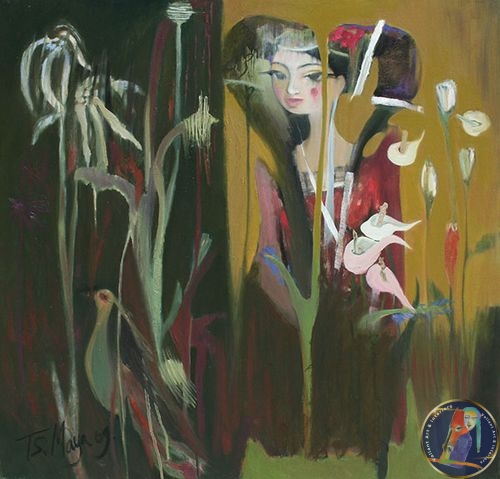
Flower Girl

Mydagmaa Tserenpil , 2010 , Oil On Canvas

Flower Girl is a compelling exploration of minimalist figurativism, rendered in oil on an $80 \times 80\text{cm}$ square canvas. Created in 2010, the work exemplifies Mydagmaa Tserenpil’s signature ability to blend the vast, open soul of the Mongolian landscape with a refined, contemporary abstract sensibility.

The Subject and Form

The painting depicts a central female figure, though she is not rendered with traditional anatomical precision. Instead, Tserenpil employs a stylized, elongated form that bridges the gap between a human silhouette and an organic element of nature.

  • The Figure: The “Flower Girl” is often characterized by a delicate, almost ethereal posture. Her features are typically obscured or simplified, inviting the viewer to project emotion onto her form rather than observing a specific likeness.

  • Symbolism: True to the title, the figure is integrated with floral motifs. These are not depicted as a static bouquet, but rather as bursts of color that seem to sprout from the figure’s essence, suggesting a profound thematic link between femininity and the regenerative power of the earth.

Color Palette and Texture

Tserenpil’s background in Bayankhongor, Mongolia, deeply influences the chromatic atmosphere of this piece.

  • Earth Tones vs. Vibrancy: The background likely utilizes a sophisticated palette of muted earth tones—ochres, soft grays, or sandy beiges—reminiscent of the Mongolian steppe.

  • The Focal Point: High-contrast pigments are reserved for the “flowers” and accents of the girl’s attire, creating a visual rhythm that draws the eye across the canvas.

  • Surface Quality: The oil medium is applied with a mix of smooth gradients and subtle impasto, providing a tactile depth that makes the minimalist composition feel expansive rather than empty.

Historical Significance

This specific work gained international recognition when it was exhibited at the “Art Shopping” exhibition at the Carrousel Du Louvre in Paris in 2010. Standing at the intersection of Mongolian heritage and global abstraction, Flower Girl serves as a bridge between the artist’s nomadic roots and the high-art circles of Europe.

  • Mydagmaa Tserenpil
  • Abstract, Calligraphy
  • Oil On Canvas
  • MYD62/010
  • 80 x 80cm
  • Mongolian Art Gallery

Add Your Comment

Mongolian Art Gallery © 2025. All Rights Reserved
Privacy Policy / Terms of Use

Flower Girl is a compelling exploration of minimalist figurativism, rendered in oil on an $80 \times 80\text{cm}$ square canvas. Created in 2010, the work exemplifies Mydagmaa Tserenpil’s signature ability to blend the vast, open soul of the Mongolian landscape with a refined, contemporary abstract sensibility.

The Subject and Form

The painting depicts a central female figure, though she is not rendered with traditional anatomical precision. Instead, Tserenpil employs a stylized, elongated form that bridges the gap between a human silhouette and an organic element of nature.

  • The Figure: The “Flower Girl” is often characterized by a delicate, almost ethereal posture. Her features are typically obscured or simplified, inviting the viewer to project emotion onto her form rather than observing a specific likeness.

  • Symbolism: True to the title, the figure is integrated with floral motifs. These are not depicted as a static bouquet, but rather as bursts of color that seem to sprout from the figure’s essence, suggesting a profound thematic link between femininity and the regenerative power of the earth.

Color Palette and Texture

Tserenpil’s background in Bayankhongor, Mongolia, deeply influences the chromatic atmosphere of this piece.

  • Earth Tones vs. Vibrancy: The background likely utilizes a sophisticated palette of muted earth tones—ochres, soft grays, or sandy beiges—reminiscent of the Mongolian steppe.

  • The Focal Point: High-contrast pigments are reserved for the “flowers” and accents of the girl’s attire, creating a visual rhythm that draws the eye across the canvas.

  • Surface Quality: The oil medium is applied with a mix of smooth gradients and subtle impasto, providing a tactile depth that makes the minimalist composition feel expansive rather than empty.

Historical Significance

This specific work gained international recognition when it was exhibited at the “Art Shopping” exhibition at the Carrousel Du Louvre in Paris in 2010. Standing at the intersection of Mongolian heritage and global abstraction, Flower Girl serves as a bridge between the artist’s nomadic roots and the high-art circles of Europe.