
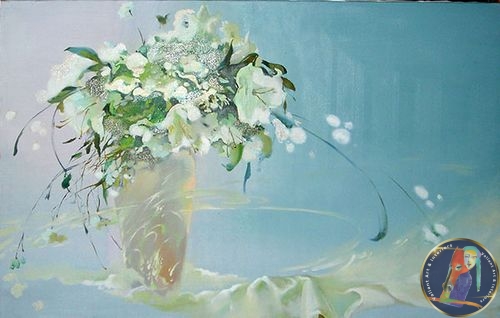
Painted in 2005, Flower is a compelling testament to Narantsetseg Dorj’s mastery of the Russian Academic tradition, refined during her decade of study at the prestigious V.I. Surikov Fine Art Academy in Moscow. While the title suggests a singular focus, the work is a sophisticated exploration of texture, light, and the quiet dignity of Mongolian still-life subjects.
Visual Composition and Technique
The painting showcases Dorj’s firm command of Realism, characterized by a deliberate and confident application of oil paint.
Subject Matter: The central floral arrangement serves as a vessel for the artist to explore the play of light on organic forms. The petals are rendered with soft, blended brushstrokes that capture the delicate fragility of the bloom, contrasted against the more structured, weighted presence of the vase or surrounding foliage.
Color Palette: Drawing from her Mongolian roots and her professional experience in theater design, Dorj utilizes a rich, grounded palette. Expect deep, earthy undertones—reminiscent of the Mongolian landscape—punctuated by the vibrant, luminous hues of the flower itself.
Chiaroscuro Effects: Influence from her Moscow training is evident in the dramatic use of light and shadow. The light source is focused, creating a sense of three-dimensionality that lifts the flower from the two-dimensional canvas, giving the composition a sculptural quality.
Context and Artistic Significance
Created during her period as a freelance artist, Flower represents a mature phase in Dorj’s career. By 2005, she had successfully integrated the rigorous technical standards of the Moscow Academy with the emotive, atmospheric sensibilities of Mongolian art.
The painting transcends a simple botanical study; it reflects the artist’s “Portrait” style—treating the flower not just as an object, but as a subject with its own character and presence. It stands as a bridge between her early years at the Youth Theatre in Darkhan and her established reputation within the Union of Mongolian Artists (UMA).