

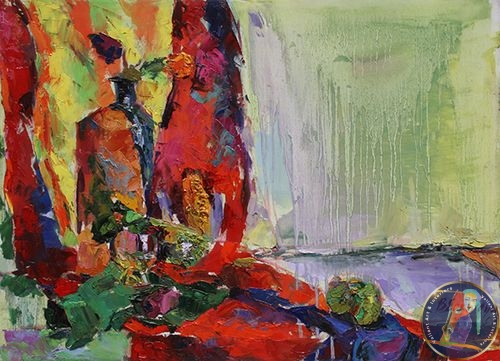
Flower 2 is a compelling exploration of form and atmosphere by Mongolian contemporary artist Enkhtuya Byambasuren. Painted in 2008, this oil-on-canvas work measures 50 x 70 cm and represents a sophisticated intersection between traditional still life and modern abstraction.
Visual Composition and Style
The painting departs from botanical literalism, opting instead for a Contemporary Still Life approach that prioritizes emotional resonance over anatomical accuracy. Byambasuren utilizes the tactile qualities of oil paint to create a surface rich with movement. The floral subject is rendered through a series of fluid, sweeping brushstrokes that suggest the delicate fragility of petals while maintaining a robust, structural presence on the canvas.
The “Abstract Modern” influence is evident in the artist’s treatment of space. The background is not a static interior but a textured environment where light and shadow intermingle, blurring the boundaries between the subject and its surroundings. This technique creates a sense of ethereal suspension, as if the flowers are emerging from or dissolving into a dreamlike haze.
Color Palette and Light
The palette is a masterful display of tonal harmony. Byambasuren employs a sophisticated range of hues—likely drawing on the soft earth tones and vibrant accents characteristic of her early 2000s period—to evoke a specific mood. The light in Flower 2 appears filtered, casting a soft glow that highlights the impasto textures and adds a three-dimensional quality to the 50 x 70 cm surface.
Context and Significance
As an artist born in Ulaanbaatar in 1984, Byambasuren belongs to a generation of Mongolian painters who have successfully integrated nomadic cultural sensibilities with international abstract movements. Flower 2 serves as a bridge in her body of work, showcasing her ability to take a classical motif—the flower—and recontextualize it through a lens of modern introspection.
The work invites the viewer to look beyond the decorative, focusing instead on the rhythm of growth and the fleeting nature of beauty. It stands as a testament to Byambasuren’s skill in capturing the “essence” of a subject, making it a vital piece for collectors of contemporary Central Asian art.
