

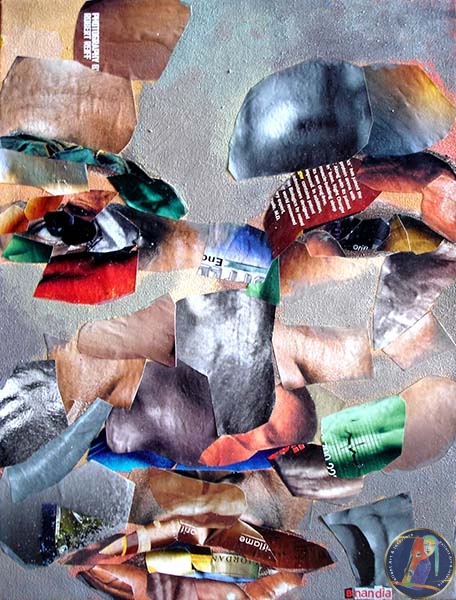
Nandin-erdene Budzagd’s 2006 work, Face, is a compelling synthesis of her academic training in Ulaanbaatar and her evolving signature style, which dances between minimalism and geometric abstraction. Created during the final year of her Master’s degree at the University of Arts and Culture, this mixed-media piece marks a pivotal moment in her career, reflecting a sophisticated shift away from traditional realism toward a more cerebral, structured figurative form.
Composition and Form
At 80 x 60 cm, the portrait is intimate yet commanding. Budzagd deconstructs the human visage into a series of calculated, overlapping planes. The “face” is not a literal representation but a geometric architecture; the artist utilizes the interplay of vertical and horizontal lines to suggest the bridge of a nose, the curve of a cheek, or the depth of an eye socket without fully defining them.
Geometric Precision: The influence of her Mongolian roots is subtly felt in the structural stability of the work, which often mirrors the clean lines found in traditional architectural motifs and nomadic textiles.
Minimalist Restraint: By stripping away superfluous detail, Budzagd focuses on the “essence” of the subject. The negative space is as vital as the painted areas, creating a sense of quietude and psychological depth.
Media and Texture
The use of mixed media allows for a rich, tactile surface that contrasts with the flat nature of minimalist design.
Layering: The artist likely employs a combination of pigments, perhaps incorporating textural elements like sand, paper, or thick impasto to create “scars” or ridges on the canvas.
Depth: This physical depth mimics the complexity of human identity—suggesting that a face is not just a surface, but a history built of many layers.
Style and Influence
The painting sits firmly at the intersection of the Figurative and the Abstract. While the title anchors the viewer in the familiar territory of portraiture, the execution pushes the boundaries of perception.
Color Palette: Typically characterized by earthy, muted tones—ochres, grays, and deep ambers—interrupted by sharp, deliberate strokes of high-contrast color.
Cultural Context: As a Mongolian artist born in the early 80s, Budzagd represents a generation that moved past Socialist Realism. Face embodies this freedom, utilizing global modernist aesthetics to explore a deeply personal, internal landscape.
