
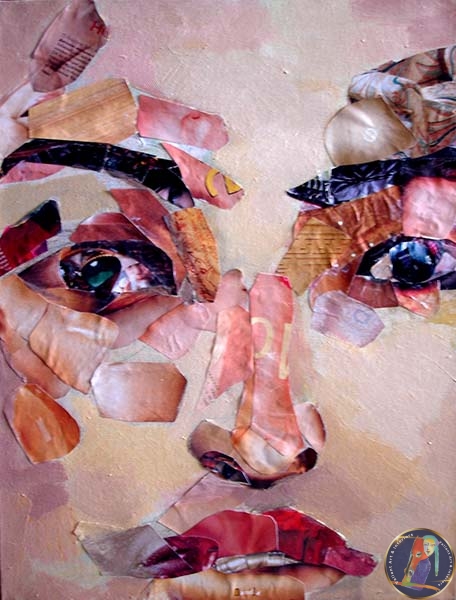
The painting Face (2006) by Mongolian artist Nandin-erdene Budzagd is a compelling synthesis of her academic background and her exploration of minimalist abstraction. Measuring 80 x 60 cm, this mixed-media work serves as a pivotal bridge between her figurative training at the Institute of Fine Art and the more conceptual, geometric style she refined during her Master’s studies.
Visual Composition and Style
The work is characterized by a deliberate tension between geometric precision and organic form. True to Budzagd’s signature style, the “face” is not a literal portrait but an architectural reconstruction of human features.
Structural Minimalist: The composition utilizes clean, sharp lines to delineate the contours of the head and features. Rather than soft transitions, the artist uses blocks of color and intersecting planes to suggest depth.
Geometric Abstraction: The eyes, nose, and mouth are reduced to essential shapes—triangles, semicircles, and rectangles—creating a mask-like quality that feels both ancient and futuristic.
Texture and Surface: Being a mixed-media piece, the surface likely features a tactile quality. Budzagd often incorporates varied materials to create a “skin” for the canvas that feels weathered or layered, adding a sense of history to the contemporary aesthetic.
Color Palette and Atmosphere
The palette typically reflects the artist’s Mongolian roots, often leaning into earthy, muted tones punctuated by bold, singular accents.
The 2006 period of her work frequently utilized ochres, deep grays, and off-whites, allowing the focus to remain on the structural integrity of the “Face.”
The lighting is not directional; instead, the “glow” of the piece comes from the contrast between the layered mixed-media elements and the flat, minimalist background.
Conceptual Undertones
Produced in the final year of her Master’s degree at the University of Arts and Culture, Face represents a departure from traditional Mongolian realism.
The Individual vs. The Universal: By stripping away specific identity through abstraction, Budzagd transforms the subject into a universal icon of human presence.
Cultural Synthesis: The piece mirrors the landscape of modern Mongolia—a place where nomadic tradition (the organic) meets rapid urbanization and modern structure (the geometric).