
Eye

Tolgan Janatkhan , 2005 , Oil On Canvas

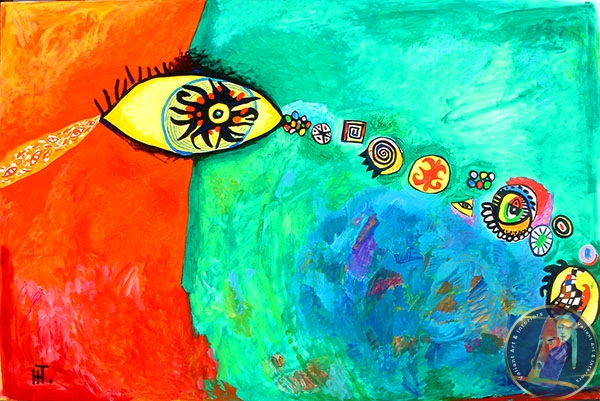
Eye is a large-scale, horizontally oriented oil painting measuring 100 by 150 cm. The composition is dominated by a sweeping, stylized representation of a human eye, which is reimagined through a lens of expressive abstraction and rich cultural symbolism. Rather than a strictly anatomical rendering, the eye functions as a vast landscape or a cosmic portal, stretching across the expanse of the canvas.

At the center of the canvas lies the iris and pupil, rendered not as flat circles but as a dense, swirling vortex of color. The pupil forms a deep, obsidian focal point that seems to draw the viewer’s gaze inward. Radiating outward from this center, the iris is built up with intricate, staccato brushstrokes and heavy impasto texture, suggesting the fibrous patterns of an actual eye while echoing the expansive topography of the Mongolian steppes or celestial rings.

Color Palette and Light

The color palette is both grounded and vibrant, balancing deep earth tones with brilliant, saturated hues. Janatkhan utilizes a base of rich ochres, deep umbers, and burnt sienna to frame the composition, establishing a warm, organic weightiness. Within the eye itself, flashes of vivid lapis lazuli, turquoise, and piercing emerald green disrupt the earthy foundation, creating a striking luminous contrast.

Light does not originate from a singular, external source; rather, the painting appears to be self-illuminated. Glints of stark titanium white and shimmering golds are strategically placed across the iris and along the curve of the eyelid, mimicking the natural reflection of light on a wet surface, but heightened to create an ethereal, jewel-like brilliance.

Texture and Execution

Executed entirely in oil on canvas, the painting exhibits a masterful command of texture. Janatkhan employs a dynamic mix of techniques, alternating between smooth, blended glazes that give the sclera (the white of the eye) a translucent, cloud-like quality, and thick, sculptural palette-knife applications. The borders of the eye melt into the background through feathered, bleeding edges, blending the physical structure of the eye into a broader, atmospheric void. The physical weight of the paint layers gives the artwork a tactile, three-dimensional presence, catching ambient gallery light across its varied topography.

Mood and Interpretation

The immense scale of the canvas (100 x 150 cm) confronts the viewer, reversing the traditional dynamics of looking—the artwork actively watches the observer. The mood is one of profound introspection, mysticism, and quiet intensity. By blowing up a singular anatomical feature to a grand scale, Janatkhan bridges the gap between the micro-world of human emotion and the macro-world of the cosmos, a thematic nod to the vast horizons and spiritual heritage of his Mongolian roots. The painting stands as a powerful exploration of perception, memory, and the universal human gaze.
  • Tolgan Janatkhan
  • Ulaanbaatar, Mongolia
  • Abstract, Geometric, Minimalist
  • Oil on canvas
  • TOL50/006
  • 100 x 150cm39" x 59"
  • Valiant Art & Interiors

Add Your Comment

Mongolian Art Gallery © 2025. All Rights Reserved
Privacy Policy / Terms of Use

Eye is a large-scale, horizontally oriented oil painting measuring 100 by 150 cm. The composition is dominated by a sweeping, stylized representation of a human eye, which is reimagined through a lens of expressive abstraction and rich cultural symbolism. Rather than a strictly anatomical rendering, the eye functions as a vast landscape or a cosmic portal, stretching across the expanse of the canvas.

At the center of the canvas lies the iris and pupil, rendered not as flat circles but as a dense, swirling vortex of color. The pupil forms a deep, obsidian focal point that seems to draw the viewer’s gaze inward. Radiating outward from this center, the iris is built up with intricate, staccato brushstrokes and heavy impasto texture, suggesting the fibrous patterns of an actual eye while echoing the expansive topography of the Mongolian steppes or celestial rings.

Color Palette and Light

The color palette is both grounded and vibrant, balancing deep earth tones with brilliant, saturated hues. Janatkhan utilizes a base of rich ochres, deep umbers, and burnt sienna to frame the composition, establishing a warm, organic weightiness. Within the eye itself, flashes of vivid lapis lazuli, turquoise, and piercing emerald green disrupt the earthy foundation, creating a striking luminous contrast.

Light does not originate from a singular, external source; rather, the painting appears to be self-illuminated. Glints of stark titanium white and shimmering golds are strategically placed across the iris and along the curve of the eyelid, mimicking the natural reflection of light on a wet surface, but heightened to create an ethereal, jewel-like brilliance.

Texture and Execution

Executed entirely in oil on canvas, the painting exhibits a masterful command of texture. Janatkhan employs a dynamic mix of techniques, alternating between smooth, blended glazes that give the sclera (the white of the eye) a translucent, cloud-like quality, and thick, sculptural palette-knife applications. The borders of the eye melt into the background through feathered, bleeding edges, blending the physical structure of the eye into a broader, atmospheric void. The physical weight of the paint layers gives the artwork a tactile, three-dimensional presence, catching ambient gallery light across its varied topography.

Mood and Interpretation

The immense scale of the canvas (100 x 150 cm) confronts the viewer, reversing the traditional dynamics of looking—the artwork actively watches the observer. The mood is one of profound introspection, mysticism, and quiet intensity. By blowing up a singular anatomical feature to a grand scale, Janatkhan bridges the gap between the micro-world of human emotion and the macro-world of the cosmos, a thematic nod to the vast horizons and spiritual heritage of his Mongolian roots. The painting stands as a powerful exploration of perception, memory, and the universal human gaze.