

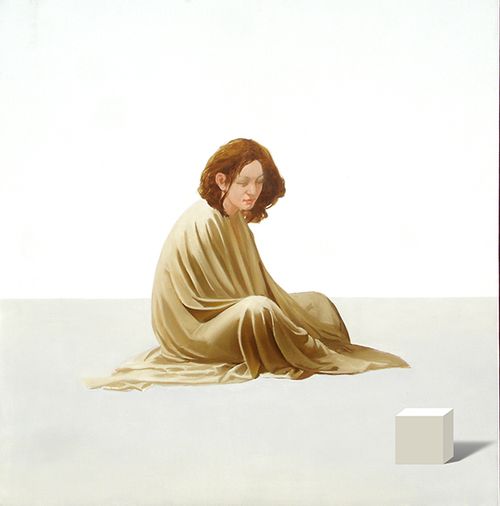
Existence 1 is a profound testament to the technical mastery and philosophical depth of Mongolian artist Erdene Dash. Painted in 2007, just two years before his untimely passing, this oil-on-canvas work ($100 \times 95$ cm) serves as a pinnacle of his education at the prestigious Repin Academy of Arts. It seamlessly bridges the gap between strict Russian Academic Realism and a deeply personal, nature-centric spirituality.
Visual Composition and Narrative
The painting features a central nude figure integrated into a vast, atmospheric landscape. Rather than treating the human form and the environment as separate entities, Dash treats them as a singular, breathing organism.
The Figure: The anatomy is rendered with clinical precision, a hallmark of Dash’s training in Saint Petersburg. Every muscle, tendon, and skin tone variation is captured with a lifelike quality. The figure’s posture is one of vulnerability and quiet strength—meditative, rather than provocative. The nudity here symbolizes a return to a “primordial state,” stripped of cultural or temporal markers, representing humanity in its purest form.
The Landscape: The background likely draws inspiration from the rugged, expansive terrain of Dash’s native Mongolia. It is not merely a backdrop but a character in itself. The use of Realism allows for the tactile depiction of earth, stone, and air, creating a sense of “groundedness.”
The Intersection: The lighting in the piece is crucial; a soft, naturalistic glow illuminates the figure, mirroring the light hitting the distant horizon. This creates a visual harmony that suggests the figure is emerging from—or dissolving into—the earth.
Technical Execution and Style
Erdene Dash’s style in Existence 1 is a sophisticated blend of Figurative Art and Nature-Inspired Realism.
Brushwork: While the figure displays smooth, blended transitions characteristic of high realism, the surrounding landscape often features more textured, visceral brushwork, providing a sensory contrast between the softness of human skin and the hardness of the wild.
Color Palette: The palette is likely dominated by earth tones—ochres, sienna, and muted greens—punctuated by the translucent, pearlescent qualities of the figure’s flesh. This restricted color scheme focuses the viewer’s attention on the interplay of light and shadow (chiaroscuro).
Scale: At $100 \times 95$ cm, the nearly square format provides a balanced, stable frame that anchors the composition, making the “existence” of the subject feel monumental and eternal.
Thematic Significance
The title, Existence 1, implies the beginning of a cycle or a fundamental truth. Given Dash’s background, the painting explores the oneness of man and nature. It rejects the industrial or modern world in favor of a timeless dialogue between the body and the land.
The work stands as a bridge between two worlds: the rigorous, formal traditions of European art education and the nomadic, sky-worshipping heritage of Mongolia. It is a quiet, powerful meditation on what it means to simply “be” within the context of the natural world.