
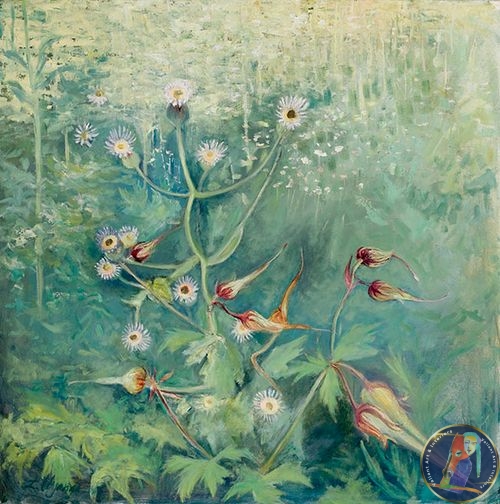
Enkhrii, a compelling oil on canvas work from 2005, represents a sophisticated intersection of classical academic training and traditional Mongolian cultural identity. Created by Uyanga Zorig, the painting utilizes a balanced $100 \times 100\text{ cm}$ square format, a compositional choice that centers the viewer’s focus and provides a sense of contemplative stability.
Visual Composition and Subject Matter
The title, which translates to “Dear” or “Tenderly Loved,” sets the emotional tone for the piece. Drawing from her expertise in figurative realism, Zorig captures a moment of profound intimacy and softness. The application of oil paint is characterized by smooth transitions and a refined palette, likely emphasizing the delicate textures of skin or traditional fabrics.
The influence of her education at the Repin Academy of Fine Art is evident in the structural integrity of the forms and the masterful handling of light. There is a perceptible depth to the work, where the artist uses subtle chiaroscuro to give the subject a three-dimensional presence.
Style and Technique
Zorig’s work often bridges the gap between still life precision and figurative emotion. In Enkhrii, this is expressed through:
Refined Realism: A meticulous attention to detail that honors the physical reality of the subject while elevating it through an idealized, aesthetic lens.
Cultural Symbology: Given the artist’s background and her leadership in the Mongolian Graphic Artists’ Association, the painting likely incorporates subtle elements of Mongolian heritage, perhaps through the specific drape of a garment or the symbolic placement of an object within the frame.
Linear Elegance: Her proficiency in calligraphy informs the brushwork, lending a rhythmic flow to the contours and an intentionality to every line.