
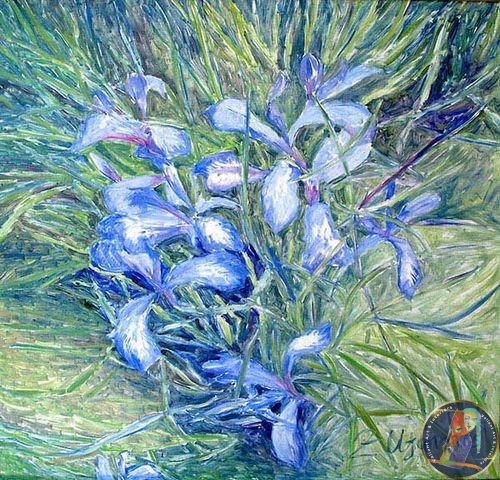
Enkhrii 4 is a compelling oil on canvas work by the distinguished Mongolian artist Uyanga Zorig. Measuring 100 x 100 cm, this square-format composition exemplifies the artist’s mastery of Realism and Figurative art, likely infused with the delicate sensibilities of her background in Still Life and Calligraphy.
The title “Enkhrii,” which translates from Mongolian as “tender,” “darling,” or “cherished,” sets a deeply emotive tone for the piece. Created in 2005, the painting represents a mature period in Zorig’s career, following her rigorous academic training at the Repin Academy of Fine Art in Saint Petersburg. This classical Russian influence is evident in the technical precision of the brushwork and the sophisticated manipulation of light and shadow (chiaroscuro) used to define form.
Visual Characteristics and Style
Compositional Balance: Utilizing the 100 x 100 cm canvas, Zorig often employs a centralized focus that draws the viewer into an intimate space. Her work frequently bridges the gap between traditional Mongolian heritage and contemporary realism.
Texture and Medium: The use of oil on canvas allows for rich, layered textures. Zorig’s technique often involves fine, controlled strokes that emphasize the tactile quality of her subjects—whether it be the softness of skin, the intricate weave of a traditional garment, or the weathered patina of an heirloom.
Cultural Synthesis: Given Zorig’s association with calligraphy and her involvement in the 750th anniversary of The Secret History of the Mongols, Enkhrii 4 likely incorporates subtle symbolic elements or rhythmic lines that echo the grace of Mongolian script.
Artistic Context
As the Head of the Mongolian Graphic Artists’ Association (appointed in 2003), Zorig’s work in the mid-2000s reflects a high level of technical authority and cultural leadership. This particular painting serves as a testament to the “Mongolian School” of realism—a style that is not merely imitative of Western traditions but is deeply rooted in the preservation of Mongolian identity and the quiet, “tender” moments of human experience.
The piece stands as a significant example of how classical training from the Repin Academy can be harmonized with the nomadic spirit and aesthetic soul of Ulaanbaatar, resulting in a work that is both universally accessible and distinctly Mongolian.