
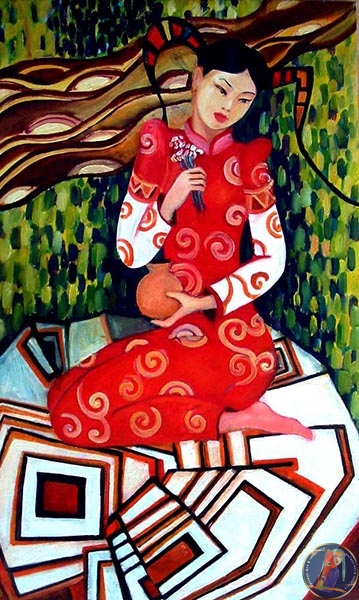
Empathy is a poignant reflection of Munkhtsetseg Bavuudorj’s signature fusion of figurative storytelling and abstract emotionalism. Painted in 2005, this relatively intimate oil-on-canvas work explores the profound psychological connection between beings, captured through a lens of Mongolian spiritual sensitivity.
Composition and Style
The painting utilizes a horizontal format that emphasizes a sense of closeness and shared space. True to Bavuudorj’s Expressionist leanings, the work avoids rigid realism in favor of evocative, fluid forms.
The Figurative Element: The central focus typically involves elongated or ethereal figures—often feminine or maternal—whose boundaries seem to blur into one another. This “melting” of outlines serves as a visual metaphor for the title, suggesting that empathy is the literal dissolving of the barrier between the “self” and the “other.”
The Palette: The 2005 period of Bavuudorj’s work often features a sophisticated interplay of earthy ochres, deep crimsons, and ghostly whites. The oil paint is applied with varied textures, ranging from translucent glazes that feel skin-like to thicker, more urgent brushstrokes that convey internal turmoil or deep compassion.
Symbolism: In line with her Mongolian heritage and her mastery of classical and contemporary styles, the painting likely incorporates subtle anatomical distortions. These are not meant to be grotesque, but rather to highlight the “inner body”—the seat of feeling and healing.
Atmosphere and Intent
The 30 x 50 cm scale draws the viewer into a private, almost meditative encounter. There is a palpable stillness to the work, yet it vibrates with the intensity of shared experience. Bavuudorj, an artist deeply influenced by themes of motherhood, femininity, and the fragility of life, uses Empathy to act as a silent bridge between the internal psychological world and the external physical reality.