

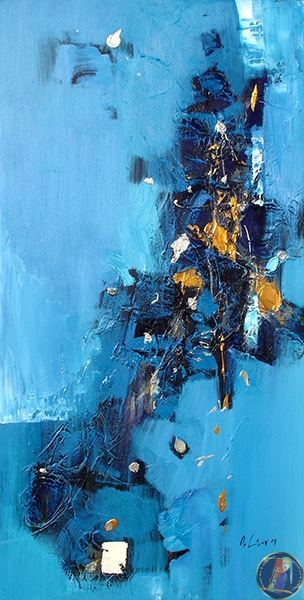
Dark Blue Composition is a compelling exploration of atmosphere and depth, created during a period when Enkhtaivan Ochirbat was firmly established as both an educator and a prominent figure in the Mongolian contemporary art scene. Measuring 45 x 90 cm—a wide, panoramic format—the painting utilizes its horizontal orientation to evoke a sense of vast, cinematic space typical of the Mongolian landscape, even when rendered through an abstract lens.
Visual Breakdown
Color Palette and Mood: As the title suggests, the work is dominated by a profound exploration of ultramarine, navy, and midnight blues. Ochirbat utilizes the oil medium to create rich, translucent layers that suggest a nocturnal or underwater environment. The “Dark Blue” is not monolithic; it is punctuated by subtle shifts in value and temperature, ranging from cold, icy tints to deep, obsidian shadows.
Composition and Form: True to his “Abstract Modern” and “Expressionist” roots, the artist eschews literal representation. The composition is likely structured around horizontal bands or sweeping gestural strokes that mimic the horizon line of the steppes. However, these forms are softened and blurred, leaning into a Contemporary Figurative Landscape style where the “figures” may be nothing more than suggestive shadows or peaks of light breaking through the blue expanse.
Texture and Technique: Given Ochirbat’s background and the era of the piece, the brushwork is likely a mix of impasto (thickly applied paint) and smoother, blended gradients. The texture adds a tactile dimension to the canvas, where the physical “weight” of the oil paint contrasts with the ethereal, airy quality of the blue hues.
Contextual Significance
Created in 2008, this piece sits at a midpoint in Ochirbat’s career, following international exposure in the United States, Russia, and Europe. It reflects a sophisticated synthesis of his formal academic training (1993–1998) and the rugged, expansive aesthetic of his Mongolian heritage.
The painting functions as a bridge between the physicality of the earth and the abstraction of emotion. It captures the “Expressionist” intent of conveying an internal state—perhaps solitude, peace, or the overwhelming scale of nature—rather than a mere geographic location.