Dancing

Enkhjargal Tsagaandari , 2007 , Oil On Canvas

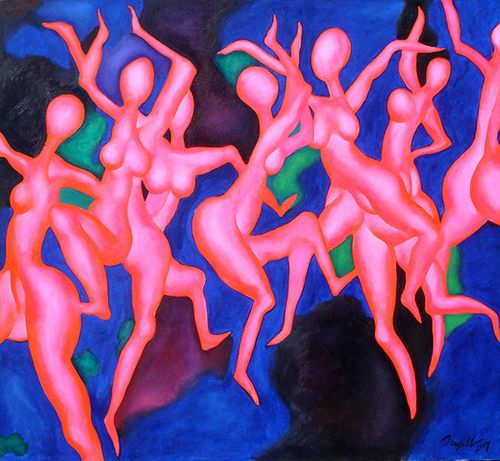
In this expansive oil painting, Enkhjargal Tsagaandari masterfully blends figurative movement with abstract modernism. True to the artist’s Mongolian roots and her evolution into freelance contemporary art, Dancing is a vibrant exploration of rhythm and space.

The composition is characterized by a fluid, sweeping energy that defies rigid structure. While the title suggests human movement, Tsagaandari uses her background in monumental art and landscape to treat the figures as an extension of the natural world. The “dancers” are rendered with expressive, elongated strokes that blur the lines between human form and elemental forces like wind or flame.

Style and Technique

  • Color Palette: The artist employs a rich, layered application of oil paint, likely utilizing the bold earthy tones of the Mongolian steppe contrasted with contemporary, vivid highlights. The interplay of light suggests a sense of depth that leans into her nature-associated style.

  • Brushwork: There is a palpable sense of “painterly” freedom here. Her experience as a teacher at the College of Fine Art is evident in the technical precision of the layering, yet her post-2000 freelance era shines through in the uninhibited, gestural marks that define the subjects’ motion.

  • Spatial Dynamics: At 100 x 120 cm, the canvas offers a wide, cinematic field. The figures are not centered; instead, they appear to drift across the canvas, suggesting a moment captured in transition—a hallmark of Modern/Contemporary Mongolian art which seeks to bridge nomadic traditions with global abstract trends.

Contextual Significance

Created in 2007, Dancing represents Tsagaandari in her prime as an independent creator. Having spent decades working within state-affiliated branches (UMA) and military institutes, this work reflects the liberation of her “Freelance” period. It synthesizes the figurative training of her early career with the abstracted freedom of her later years, moving away from the static “Monumental” style toward something rhythmic, ethereal, and deeply personal.

The painting stands as a testament to her position in the lineage of Mongolian artists who successfully transitioned from the formal structures of the late 20th century to the expressive autonomy of the 21st.
  • Enkhjargal Tsagaandari
  • Photorealism, Sculpture
  • Oil On Canvas
  • ENJ25/012
  • 100 x 120cm
  • Mongolian Art Gallery

Add Your Comment

Mongolian Art Gallery © 2025. All Rights Reserved
Privacy Policy / Terms of Use

In this expansive oil painting, Enkhjargal Tsagaandari masterfully blends figurative movement with abstract modernism. True to the artist’s Mongolian roots and her evolution into freelance contemporary art, Dancing is a vibrant exploration of rhythm and space.

The composition is characterized by a fluid, sweeping energy that defies rigid structure. While the title suggests human movement, Tsagaandari uses her background in monumental art and landscape to treat the figures as an extension of the natural world. The “dancers” are rendered with expressive, elongated strokes that blur the lines between human form and elemental forces like wind or flame.

Style and Technique

  • Color Palette: The artist employs a rich, layered application of oil paint, likely utilizing the bold earthy tones of the Mongolian steppe contrasted with contemporary, vivid highlights. The interplay of light suggests a sense of depth that leans into her nature-associated style.

  • Brushwork: There is a palpable sense of “painterly” freedom here. Her experience as a teacher at the College of Fine Art is evident in the technical precision of the layering, yet her post-2000 freelance era shines through in the uninhibited, gestural marks that define the subjects’ motion.

  • Spatial Dynamics: At 100 x 120 cm, the canvas offers a wide, cinematic field. The figures are not centered; instead, they appear to drift across the canvas, suggesting a moment captured in transition—a hallmark of Modern/Contemporary Mongolian art which seeks to bridge nomadic traditions with global abstract trends.

Contextual Significance

Created in 2007, Dancing represents Tsagaandari in her prime as an independent creator. Having spent decades working within state-affiliated branches (UMA) and military institutes, this work reflects the liberation of her “Freelance” period. It synthesizes the figurative training of her early career with the abstracted freedom of her later years, moving away from the static “Monumental” style toward something rhythmic, ethereal, and deeply personal.

The painting stands as a testament to her position in the lineage of Mongolian artists who successfully transitioned from the formal structures of the late 20th century to the expressive autonomy of the 21st.