
Dancing

Ganbold / Bono Dorjderem , 2009 , Oil On Canvas

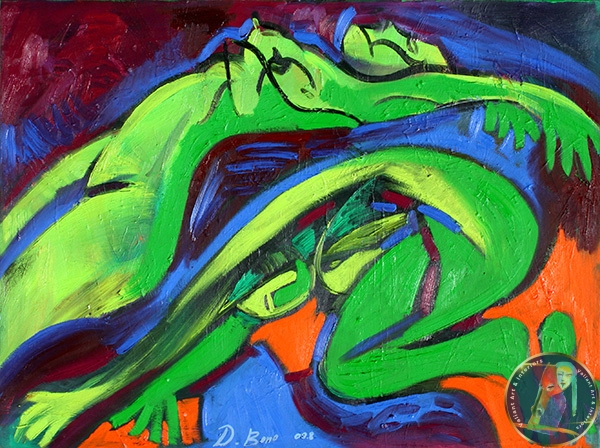
Dancing is a compelling synthesis of contemporary figuration and expressive abstraction. Typical of Ganbold’s celebrated style, the work explores the human form not through rigid anatomical precision, but through the fluid, rhythmic energy of movement. The composition captures a nude figure in mid-motion, blurring the lines between the physical body and the space it inhabits.

Composition and Style

The painting utilizes a horizontal 70 x 100 cm orientation, providing an expansive stage for the subject’s kinetic energy. Ganbold employs a sophisticated interplay of styles:

  • Figurative Foundations: The central focus remains on the human silhouette. The limbs are elongated and stylized, suggesting a grace that transcends mere athleticism.

  • Abstract Execution: Rather than defined outlines, the “dance” is rendered through sweeping brushstrokes and layered textures. The background and foreground often merge, suggesting that the dancer is not just moving through space, but is an integral part of the atmosphere itself.

  • Modern Sensibility: There is a stark, “Aphorizmic” quality to the work—a reduction of the subject to its most essential emotional truth, consistent with the artist’s mid-2000s solo explorations of freedom and philosophy.

Color Palette and Technique

The use of oil on canvas allows for rich, luminous transitions. The palette often balances earthy, grounded tones reflective of Mongolian aesthetics with sudden bursts of contemporary vibrance.

  • Texture: Thick impasto sections may contrast with thinner, translucent glazes, creating a sense of depth and vibration.

  • Light: Light is treated as a dynamic element, seemingly radiating from the point of physical exertion or the “pivot” of the dance, highlighting the contours of the nude form while casting others into atmospheric shadow.

Thematic Context

Created by an artist who gained prominence during the “Great Mongolia 800” era, Dancing represents a departure from traditional nomadic realism toward a more universal, emotive language. It stands as a testament to Ganbold’s fascination with the concept of “Freedom”—both in the physical liberation of the body and the stylistic liberation of the artist’s hand.

Dancing is less a portrait of a person and more a portrait of an impulse; it captures the fleeting moment where the physical self dissolves into pure rhythm.
  • Ganbold / Bono Dorjderem
  • Ulaanbaatar, Mongolia
  • Abstract, Figurative, Modern/Contemporary, Nude
  • Oil On Canvas
  • GND81/049
  • 70 x 100cm27" x "
  • Valiant Art & Interiors

Add Your Comment

Mongolian Art Gallery © 2025. All Rights Reserved
Privacy Policy / Terms of Use

Dancing is a compelling synthesis of contemporary figuration and expressive abstraction. Typical of Ganbold’s celebrated style, the work explores the human form not through rigid anatomical precision, but through the fluid, rhythmic energy of movement. The composition captures a nude figure in mid-motion, blurring the lines between the physical body and the space it inhabits.

Composition and Style

The painting utilizes a horizontal 70 x 100 cm orientation, providing an expansive stage for the subject’s kinetic energy. Ganbold employs a sophisticated interplay of styles:

  • Figurative Foundations: The central focus remains on the human silhouette. The limbs are elongated and stylized, suggesting a grace that transcends mere athleticism.

  • Abstract Execution: Rather than defined outlines, the “dance” is rendered through sweeping brushstrokes and layered textures. The background and foreground often merge, suggesting that the dancer is not just moving through space, but is an integral part of the atmosphere itself.

  • Modern Sensibility: There is a stark, “Aphorizmic” quality to the work—a reduction of the subject to its most essential emotional truth, consistent with the artist’s mid-2000s solo explorations of freedom and philosophy.

Color Palette and Technique

The use of oil on canvas allows for rich, luminous transitions. The palette often balances earthy, grounded tones reflective of Mongolian aesthetics with sudden bursts of contemporary vibrance.

  • Texture: Thick impasto sections may contrast with thinner, translucent glazes, creating a sense of depth and vibration.

  • Light: Light is treated as a dynamic element, seemingly radiating from the point of physical exertion or the “pivot” of the dance, highlighting the contours of the nude form while casting others into atmospheric shadow.

Thematic Context

Created by an artist who gained prominence during the “Great Mongolia 800” era, Dancing represents a departure from traditional nomadic realism toward a more universal, emotive language. It stands as a testament to Ganbold’s fascination with the concept of “Freedom”—both in the physical liberation of the body and the stylistic liberation of the artist’s hand.

Dancing is less a portrait of a person and more a portrait of an impulse; it captures the fleeting moment where the physical self dissolves into pure rhythm.