
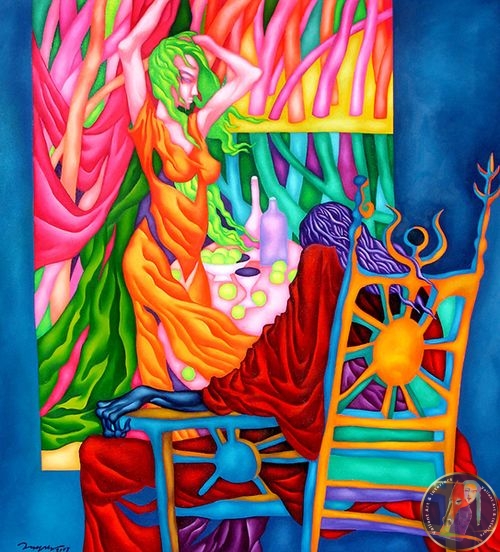
Dance (2007) is a compelling synthesis of Enkhjargal Tsagaandari’s signature styles, merging her Mongolian roots with a sophisticated modern aesthetic. Measuring 100 x 90 cm, this oil-on-canvas work captures a sense of fluid movement that straddles the line between the figurative and the abstract.
Composition and Subject Matter The painting centers on the concept of rhythmic motion. While the title suggests a physical act, the execution is deeply lyrical. Tsagaandari utilizes her background in monumental art and figurative painting to ground the piece, yet she allows the forms to dissolve into contemporary abstraction. The “dance” is not merely represented by a figure, but by the energetic interplay of light, shadow, and sweeping brushstrokes that suggest a body in a state of constant flux.
Color Palette and Texture True to the artist’s association with nature and landscape, the palette likely draws inspiration from the earthy, expansive tones of the Mongolian steppe, punctuated by the bold, vibrant hues typical of modern Mongolian contemporary art. The application of oil paint is handled with a mastery born from decades of technical experience and teaching. There is a palpable texture to the canvas—thick, confident strokes create a “visual vibration” that mimics the acoustics of music or the whistling wind of a high-altitude landscape.
Style and Influence The work reflects Tsagaandari’s transition from the structured environments of the Military Institute and Monumental Art ateliers into the freedom of her freelance career (which began in 2000). In Dance, one can see the evolution of an artist who spent years mastering form, only to intentionally break it down. The influence of her international exposure—ranging from exhibitions in China to Vienna—is evident in the way the piece speaks a universal language of abstraction while maintaining a distinct, soul-stirring Mongolian identity.
Atmosphere The painting exudes a sense of liberation. By 2007, Tsagaandari had moved beyond the rigid expectations of early-career commissions, and Dance serves as a testament to that autonomy. It is a visual celebration of space and spirit, where the boundaries between the human form and the natural world become beautifully blurred.