
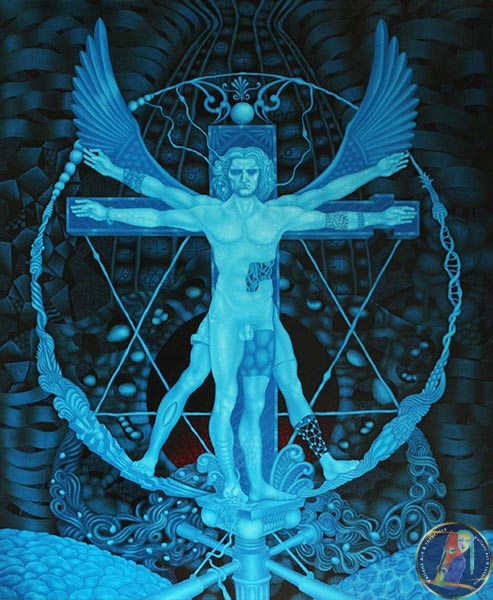
Da Vinci Messege is a monumental work that bridges the gap between the Renaissance and contemporary Central Asian modernism. Standing at nearly three meters tall, the scale of the canvas demands a physical presence, pulling the viewer into a space where Expressionist energy meets the calculated geometry of the old masters.
The painting serves as a dialogue between Janatkhan’s Mongolian heritage and the Western art historical canon. While the title explicitly references Leonardo da Vinci, the execution is purely Modernist and Abstract, favoring raw emotion and texture over literal representation.
Composition and Technique
Janatkhan utilizes his formal training from the Institute of Fine Art to balance chaotic brushwork with a structured, almost architectural underlying grid.
The Palette: The artist employs a sophisticated interplay of earthy ochres and deep umbers—reminiscent of the Mongolian steppe—interrupted by sharp, clinical highlights of white and charcoal. This creates a “parchment” effect, suggesting an ancient manuscript or a weathered fresco.
The Figure: Central to the work is a deconstructed Portrait. Janatkhan does not paint a likeness of Da Vinci, but rather a “message” of human anatomy and intellect. The form is fragmented; lines of tension suggest the Vitruvian Man, but they are rendered with the fluid, aggressive strokes characteristic of the Expressionist style.
Texture: As an oil on canvas piece, the impasto is heavy in sections, creating a topographical surface. The paint is scraped, layered, and occasionally thinned to a wash, echoing the passage of time and the layering of history.
Style and Symbolism
True to Janatkhan’s associated styles, the painting refuses to settle into a single category.
Abstract-Expressionism: The emotional weight is carried by the “gesture” of the paint. There is a sense of urgency in the marks, representing the restless nature of human genius.
The “Message”: The “Da Vinci” element is found in the symbolic use of light and shadow (chiaroscuro). Janatkhan uses contemporary techniques to explore the same mystery found in Renaissance works—the idea that the human form is a vessel for hidden mathematical and spiritual truths.
Context in the Artist’s Career
Created in 2010, this work represents Janatkhan’s mature period, following decades of international exposure across France, Germany, and Turkey. It reflects the perspective of a nomadic soul—an artist born in Ulaanbaatar who has absorbed the aesthetics of the European cities he exhibited in during the 1990s, ultimately synthesizing them into a unique, monumental language of his own.