

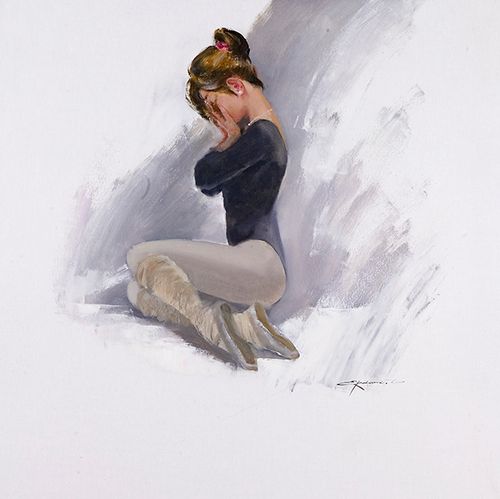
Painted in 2007, just two years before the artist’s passing, “Crying” is a poignant masterwork by Mongolian artist Erdene Dash. Executed with the technical rigorship of the Russian academic tradition and the soulful depth of Mongolian figurative art, this piece explores the visceral intersection of human vulnerability and the natural world. The square format (64 x 64 cm) focuses the viewer’s attention entirely on the tight, emotional composition of the figure within a landscape.
Composition and Figure Study
At the heart of the painting is a nude figure composition, rendered with the meticulous Realism Dash acquired during his years at the Repin Academy of Arts. The figure is depicted in a state of raw, unfiltered emotion. Rather than a mere anatomical study, the body becomes a vessel for sorrow.
The Pose: The subject is often positioned in a way that suggests a turning inward—perhaps fetal or bowed—emphasizing a sense of isolation and internal struggle.
Anatomy: Every muscle and contour is articulated with precision, using light and shadow to create a three-dimensional weight that feels both grounded and fragile.
Landscape and Nature Integration
True to Dash’s signature style, the figure is not isolated in a void but is deeply integrated into a nature-inspired setting. The landscape elements are not merely decorative; they act as an echo of the subject’s internal state.
Symbiotic Relationship: The textures of the earth, stone, or flora are painted with the same level of detail as the human skin, suggesting that the “crying” is not just a human act, but a lament shared by the earth itself.
Atmosphere: The color palette likely leans toward earthy, muted tones—ochres, deep umbers, and cool greys—which enhance the somber, contemplative mood of the piece.
Technical Execution
Leveraging his education from the Surikov Art University and the Repin Academy, Dash utilizes a sophisticated layering of oil paints.
Chiaroscuro: The play of light is dramatic, highlighting the peaks of the figure’s form while allowing the shadows to merge into the landscape.
Brushwork: While the figure displays the smooth transitions of high realism, the surrounding nature may feature more expressive, textural brushstrokes, providing a tactile contrast between the softness of the flesh and the ruggedness of the world.
Artistic Significance
“Crying” stands as a testament to Erdene Dash’s ability to bridge classical European techniques with Mongolian spiritual depth. It moves beyond simple portraiture to reach a universal allegory of grief. The painting captures a moment of profound solitude, yet by placing the figure within the vastness of nature, Dash suggests that even in our deepest sorrow, we are inextricably linked to the environment that birthed us.