
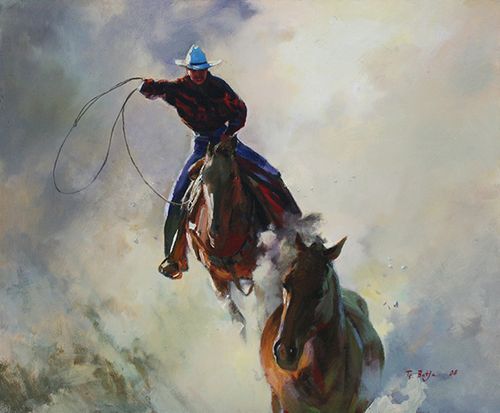
Cowboy (2008) is a masterclass in contemporary Mongolian realism, showcasing Batjargal Tseintsogzol’s ability to weave profound cultural identity into a meticulously detailed, photorealistic frame. Measuring 50 x 60 cm, the oil-on-canvas work serves as a window into the soul of the nomadic steppe.
Composition and Subject Matter
The painting features a central figure of a Mongolian horseman, captured with a level of detail that borders on the documentary. Unlike the romanticized, high-action tropes of the American “cowboy,” Tseintsogzol’s subject embodies a quiet, weathered dignity.
The Figure: The rider is often depicted in traditional Mongolian attire—the deel—rendered with such precision that the viewer can almost feel the weight of the heavy fabric and the texture of the sheepskin lining. His face is a roadmap of a life spent under the harsh Mongolian sun, characterized by deep-set eyes and sun-bronzed skin.
The Equine Connection: The horse is not merely a tool but a partner. Tseintsogzol captures the anatomy of the Mongolian horse—compact, sturdy, and muscular—with anatomical perfection. The sheen of the coat and the slight moisture on the horse’s muzzle emphasize the “Photorealism” style Batjargal was renowned for.
Style and Technique
Batjargal’s technique in Cowboy balances the clinical precision of Photorealism with the emotive depth of Classical Realism.
Light and Shadow: The artist utilizes a naturalistic lighting scheme, likely mimicking the “golden hour” of the steppe. This creates a high-contrast interplay that defines the folds of the clothing and the musculature of the horse, giving the piece a three-dimensional quality.
Palette: The color scheme is grounded in earth tones—ochres, deep browns, dusty greys, and the muted blues of a vast sky. These colors reflect the environmental reality of Mongolia, grounding the subject in his natural habitat.
Brushwork: The brushwork is nearly invisible. By using fine glazes and meticulous blending, Batjargal eliminates the “painterly” stroke to allow the subject to speak for itself, a hallmark of his post-1990s evolution toward extreme realism.
Cultural Context
Born in Ulaanbaatar in 1966, Batjargal lived through Mongolia’s transition from a socialist state to a democracy. His work, particularly Cowboy, acts as a preservation of heritage.
“His paintings are not just images; they are a silent dialogue between the ancient nomadic traditions and the modern gaze.”
In this 2008 piece, the “Cowboy” represents the endurance of the Mongolian spirit. While the title uses a Western term, the imagery reclaims the identity of the horseman as a figure of philosophical stillness and environmental harmony, rather than one of conquest.