
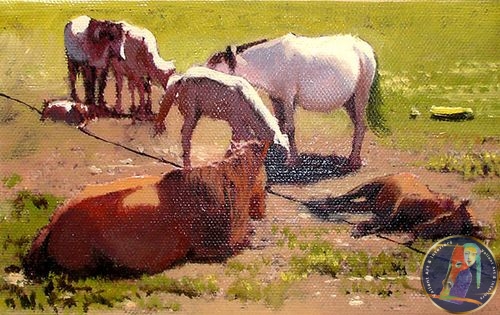
Country 2 is a masterclass in miniature realism, capturing the vast, soulful essence of the Mongolian steppe within a remarkably small 9 x 15 cm frame. Despite its diminutive size, the work pulses with the atmospheric depth and cultural heritage typical of Mergen Baidy’s evocative style.
Visual Composition and Style
Executed in oil, the painting leans heavily into Realism and Landscape—two of Baidy’s hallmark styles. Given the title and the artist’s background in Dundgobi, the composition likely focuses on the sweeping horizons of the Mongolian countryside.
The Horizon: In such a wide, short format (a nearly 2:1 aspect ratio), Baidy emphasizes the “big sky” philosophy. The horizon line is likely positioned low, allowing the sky to dominate and convey a sense of infinite space.
Color Palette: Expect a sophisticated use of earth tones—ochres, burnt sienna, and muted greens—contrasted against a high-altitude blue or the soft, hazy pastels of a Central Asian dusk.
The Miniature Scale: At only 9 x 15 cm, the detail is incredibly fine. Baidy uses delicate brushwork to suggest texture—perhaps the dry grass of the steppe, the distant silhouette of a ger (yurt), or the subtle undulations of the Gobi terrain.
Thematic Elements
As a contemporary Mongolian artist born in 1976, Baidy’s work often serves as a bridge between nomadic tradition and modern observation.
Nature and Figurative Blend: While primarily a landscape, Baidy often incorporates figurative elements or animals (notably horses, as evidenced by his 2010 exhibition at the International Equestrian Festival). In Country 2, there may be a solitary figure or a distant herd, providing a sense of scale and life to the immense wilderness.
Atmosphere: The painting likely evokes a sense of “quietude.” The realism here isn’t just about photographic accuracy; it’s about the “feeling” of the air and the stillness of a land that remains largely untouched by urban sprawl.
Context and Heritage
Created in 2006, this piece represents Baidy in his prime, blending his formal education with the rugged, naturalistic beauty of his birthplace, Dundgobi. The painting acts as a portable window into the Mongolian soul—small enough to be held in one’s hands, yet vast enough to represent an entire nation’s landscape.