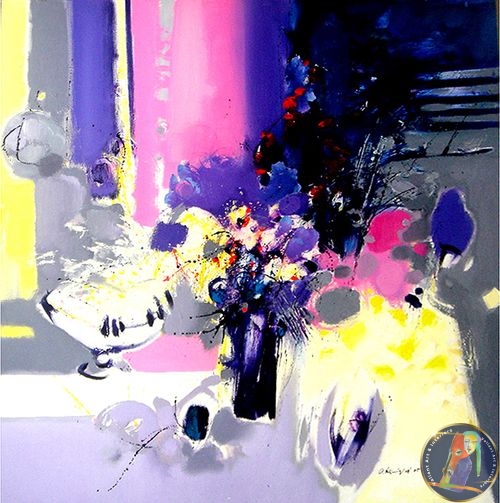
Composition 6

Enkhtaivan Ochirbat , 2005 , Oil On Canvas

Composition 6 is a quintessential example of Enkhtaivan Ochirbat’s ability to bridge the gap between Mongolian traditionalism and contemporary abstract expressionism. Measuring 100 x 100 cm, the square format creates a balanced, contained space for what is an otherwise high-energy exploration of color and form.

Key Visual Elements

  • Color Palette and Atmosphere: True to his “Expressionist” label, Ochirbat utilizes a palette that likely draws from the raw, earthy tones of the Mongolian steppe, punctuated by bold, modern synthetics. The year 2005 marked a period where his work leaned heavily into the “Color” exhibition series, suggesting a mastery of saturated pigments. You can expect a sophisticated interplay of deep ochres, sky blues, and perhaps the fiery reds or golds often found in Buddhist iconographic traditions, though filtered through a modern lens.

  • Brushwork and Texture: Given his background as an art teacher and his involvement in the “Action” exhibition series, the application of oil on canvas is likely gestural and tactile. The paint is not just a medium for color but a physical presence on the canvas. Expect heavy impasto, visible brushstrokes, and layered textures that suggest movement—reminiscent of the wind or the rhythmic gait of horses, a recurring motif in his 2004 American exhibition.

  • Compositional Structure: As the title Composition 6 suggests, the focus is on the formal arrangement of elements rather than a literal depiction. However, Ochirbat’s “Contemporary Figurative Landscape” style often leaves “ghosts” of reality within the abstraction.

    • The Horizon: There is often a subtle tension between a flat, abstract plane and a suggested horizon line, anchoring the viewer in a sense of vast space.

    • Geometric vs. Organic: The painting likely balances sharp, structural lines (reminiscent of his “Industry and Art” influence) with fluid, organic shapes that mirror the nomadic heritage of Mongolia.

Style and Context

“Ochirbat’s work in 2005 represents a bridge between his academic training in Ulaanbaatar and the international exposure he gained in Russia, America, and Europe.”

The painting reflects a post-Soviet Mongolian identity, where artists moved away from Socialist Realism toward a more personal, emotive language. Composition 6 is less about a specific place and more about the feeling of the environment—capturing the spiritual and physical weight of the Mongolian landscape through the freedom of modern abstraction.
  • Enkhtaivan Ochirbat
  • Photorealism, Realism
  • Oil On Canvas
  • ENT21/015
  • 100 x 100cm
  • Mongolian Art Gallery

Add Your Comment

Mongolian Art Gallery © 2025. All Rights Reserved
Privacy Policy / Terms of Use

Composition 6 is a quintessential example of Enkhtaivan Ochirbat’s ability to bridge the gap between Mongolian traditionalism and contemporary abstract expressionism. Measuring 100 x 100 cm, the square format creates a balanced, contained space for what is an otherwise high-energy exploration of color and form.

Key Visual Elements

  • Color Palette and Atmosphere: True to his “Expressionist” label, Ochirbat utilizes a palette that likely draws from the raw, earthy tones of the Mongolian steppe, punctuated by bold, modern synthetics. The year 2005 marked a period where his work leaned heavily into the “Color” exhibition series, suggesting a mastery of saturated pigments. You can expect a sophisticated interplay of deep ochres, sky blues, and perhaps the fiery reds or golds often found in Buddhist iconographic traditions, though filtered through a modern lens.

  • Brushwork and Texture: Given his background as an art teacher and his involvement in the “Action” exhibition series, the application of oil on canvas is likely gestural and tactile. The paint is not just a medium for color but a physical presence on the canvas. Expect heavy impasto, visible brushstrokes, and layered textures that suggest movement—reminiscent of the wind or the rhythmic gait of horses, a recurring motif in his 2004 American exhibition.

  • Compositional Structure: As the title Composition 6 suggests, the focus is on the formal arrangement of elements rather than a literal depiction. However, Ochirbat’s “Contemporary Figurative Landscape” style often leaves “ghosts” of reality within the abstraction.

    • The Horizon: There is often a subtle tension between a flat, abstract plane and a suggested horizon line, anchoring the viewer in a sense of vast space.

    • Geometric vs. Organic: The painting likely balances sharp, structural lines (reminiscent of his “Industry and Art” influence) with fluid, organic shapes that mirror the nomadic heritage of Mongolia.

Style and Context

“Ochirbat’s work in 2005 represents a bridge between his academic training in Ulaanbaatar and the international exposure he gained in Russia, America, and Europe.”

The painting reflects a post-Soviet Mongolian identity, where artists moved away from Socialist Realism toward a more personal, emotive language. Composition 6 is less about a specific place and more about the feeling of the environment—capturing the spiritual and physical weight of the Mongolian landscape through the freedom of modern abstraction.