Composition 3

Enkhtaivan Ochirbat , 2005 , Oil On Canvas

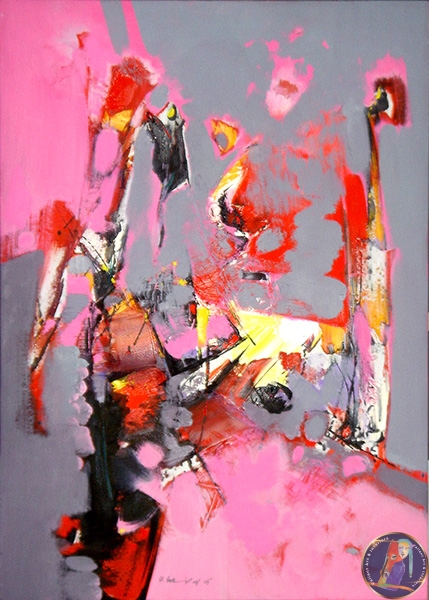
Composition 3 is a compelling synthesis of Ochirbat’s foundational Mongolian roots and his exploration of Modern Abstraction. Painted in 2005, a pivotal year that saw his work exhibited internationally in Bulgaria, Poland, and South Korea, this piece represents the height of his “Action” period. The vertical 70 x 50 cm format serves as a window into a space where traditional landscape elements are deconstructed into raw, emotional energy.

Composition and Form

True to the Contemporary Figurative Landscape style, the painting does not offer a literal depiction of the Mongolian steppe, but rather an “impression” of it.

  • Structure: The work is organized through a series of sweeping, gestural brushstrokes that suggest horizons and geological formations without adhering to strict perspective.

  • The “Action” Influence: Reflecting his involvement in the Action exhibition series (2002–2004), the application of the oil paint is thick and tactile. There is a sense of movement—impasto techniques create a physical topography on the canvas, mirroring the rugged terrain of his homeland.

Color Palette and Light

Ochirbat’s use of color in Composition 3 is both Expressionist and atmospheric.

  • Tones: Expect a sophisticated interplay of earthy ochres, deep ambers, and perhaps flashes of cerulean or slate gray, typical of the Mongolian light.

  • Contrast: The artist employs a high-contrast approach, where dark, brooding shadows collide with sudden bursts of luminous color, creating a sense of “living” space within the abstraction.

Symbolic Resonance

As a teacher at the “Industry and Art” school during this period, Ochirbat’s work displays a disciplined yet free-spirited technique. Composition 3 captures the duality of the modern Mongolian identity:

  1. The Nomadic Spirit: The fluidity of the lines evokes the constant movement of wind and nomadic life.

  2. Modernity: The abstract nature of the “Composition” series marks a departure from traditional socialist realism, leaning instead toward a universal, contemporary visual language.

Summary of Impact

The painting is a testament to Ochirbat’s ability to translate the vastness of Ulaanbaatar’s surrounding landscapes into a compact, intimate canvas. It is a work of rhythmic energy, where the physical act of painting is just as important as the subject matter itself, resulting in a piece that feels both grounded in the earth and suspended in a moment of pure emotional expression.
  • Enkhtaivan Ochirbat
  • Photorealism, Sculpture
  • Oil On Canvas
  • ENT21/017
  • 70 x 50cm
  • Mongolian Art Gallery

Add Your Comment

Mongolian Art Gallery © 2025. All Rights Reserved
Privacy Policy / Terms of Use

Composition 3 is a compelling synthesis of Ochirbat’s foundational Mongolian roots and his exploration of Modern Abstraction. Painted in 2005, a pivotal year that saw his work exhibited internationally in Bulgaria, Poland, and South Korea, this piece represents the height of his “Action” period. The vertical 70 x 50 cm format serves as a window into a space where traditional landscape elements are deconstructed into raw, emotional energy.

Composition and Form

True to the Contemporary Figurative Landscape style, the painting does not offer a literal depiction of the Mongolian steppe, but rather an “impression” of it.

  • Structure: The work is organized through a series of sweeping, gestural brushstrokes that suggest horizons and geological formations without adhering to strict perspective.

  • The “Action” Influence: Reflecting his involvement in the Action exhibition series (2002–2004), the application of the oil paint is thick and tactile. There is a sense of movement—impasto techniques create a physical topography on the canvas, mirroring the rugged terrain of his homeland.

Color Palette and Light

Ochirbat’s use of color in Composition 3 is both Expressionist and atmospheric.

  • Tones: Expect a sophisticated interplay of earthy ochres, deep ambers, and perhaps flashes of cerulean or slate gray, typical of the Mongolian light.

  • Contrast: The artist employs a high-contrast approach, where dark, brooding shadows collide with sudden bursts of luminous color, creating a sense of “living” space within the abstraction.

Symbolic Resonance

As a teacher at the “Industry and Art” school during this period, Ochirbat’s work displays a disciplined yet free-spirited technique. Composition 3 captures the duality of the modern Mongolian identity:

  1. The Nomadic Spirit: The fluidity of the lines evokes the constant movement of wind and nomadic life.

  2. Modernity: The abstract nature of the “Composition” series marks a departure from traditional socialist realism, leaning instead toward a universal, contemporary visual language.

Summary of Impact

The painting is a testament to Ochirbat’s ability to translate the vastness of Ulaanbaatar’s surrounding landscapes into a compact, intimate canvas. It is a work of rhythmic energy, where the physical act of painting is just as important as the subject matter itself, resulting in a piece that feels both grounded in the earth and suspended in a moment of pure emotional expression.