
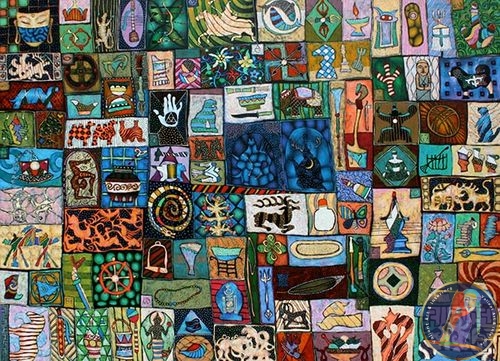
Based on the work of Oilan Janatkhan, a prominent figure in Mongolian contemporary art, Composition (2009) is a masterful synthesis of nomadic tradition and modern abstraction. Spanning an expansive 160 x 220cm canvas, the scale of the piece invites the viewer into a deep, atmospheric exploration of texture and heritage.
Visual Breakdown
The painting is a quintessential example of Janatkhan’s Expressionist style, where the physical application of oil paint becomes as much a part of the story as the subject itself.
Color Palette and Atmosphere: The work likely utilizes a grounded, earthy palette dominated by ochres, deep ambers, and shadowy umbers, punctuated by the sudden, vibrant pops of primary colors—reds or blues—often found in traditional Mongolian textiles. The lighting is non-literal; it feels as though the glow emanates from within the layers of paint rather than a single light source.
Compositional Structure: True to its title, the work balances chaotic energy with a structural “inner grid.” You can see the influence of his classical training from the Institute of Fine Art, where even his most abstract gestures are anchored by a sense of weight and proportion. The “Portrait” and “Still Life” aspects of his background merge here, as abstract shapes often hint at the silhouettes of horses, nomadic dwellings (gers), or the rugged textures of the Altai Mountains.
Brushwork and Texture: Janatkhan’s hand is visible throughout. The surface is a dense map of impasto—thick, sculptural applications of oil paint that create a three-dimensional topography. Scumbled layers reveal glimpses of underlying colors, suggesting the passage of time or the weathered surfaces of ancient petroglyphs.
Artistic Context
Created in 2009, this piece represents a mature period for Janatkhan. Having exhibited across the globe—from the experimental energy of Alma-Ata to the cultural hubs of Paris and Amsterdam—his work in Composition reflects a “global nomadic” perspective.
It is not merely an abstract painting; it is a bridge between the Modern/Contemporary art world and the spiritual lineage of Mongolia. The large-scale format (220cm width) allows the viewer to experience the “vastness” that is so central to Mongolian identity, rendered through the lens of European expressionism.