Composition 13

Enkhtaivan Ochirbat , 2008 , Oil On Canvas

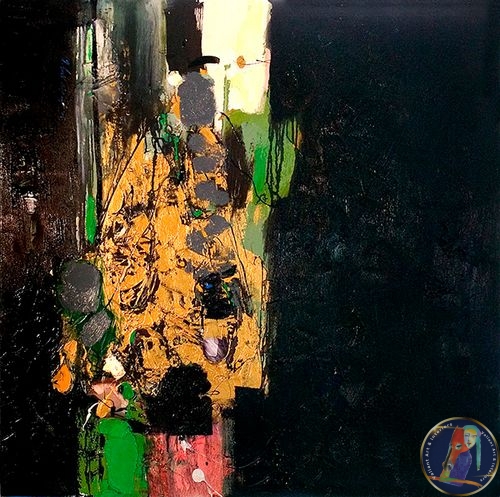
Enkhtaivan Ochirbat’s “Composition 13” (2008) is a masterful synthesis of his diverse stylistic influences, bridging the gap between contemporary figurative landscape and abstract expressionism. Executed in oil on a square $92 \times 92\text{cm}$ canvas, the work serves as a window into the artist’s unique perspective on the Mongolian environment, filtered through a lens of modern abstraction.

Visual Architecture and Color Palette

The painting is characterized by a high-energy, gestural application of oil paint. Rather than a literal depiction of a scene, Ochirbat uses a sophisticated interplay of light and texture to evoke the atmosphere of the Mongolian steppe.

  • Tonal Harmony: The palette often features earthy ochres, deep ambers, and cooler slate grays, punctuated by sudden bursts of vibrant color that suggest the fleeting shift of light over a rugged terrain.

  • The “Abstract Landscape”: While the title “Composition 13” suggests a purely formalist approach, the artist’s background in contemporary figurative landscapes is evident in the structural horizontalities of the piece. There is a perceptible “horizon” or grounding force that prevents the abstraction from becoming untethered.

Texture and Technique

Drawing from his experience as an art educator and his refined skills developed at the Art Institute, Ochirbat employs a variety of application techniques:

  • Impasto Work: Thick, tactile layers of paint create a physical topography on the canvas, mirroring the physical grit and endurance of the Central Asian landscape.

  • Expressive Brushwork: Sweeping, broad strokes interact with finer, more clinical marks, showcasing a balance between raw emotion (Expressionism) and academic control.

Artistic Context

Created during a prolific period following his international exhibitions in America, Bulgaria, and Poland, “Composition 13” represents a bridge between traditional Mongolian aesthetics and the global language of Abstract Modernism. It avoids the clichés of nomadic art, instead opting for a psychological representation of space and distance.
  • Enkhtaivan Ochirbat
  • Minimalist, Mongolian Style
  • Oil On Canvas
  • ENT21/022
  • 92 x 92cm
  • Mongolian Art Gallery

Add Your Comment

Mongolian Art Gallery © 2025. All Rights Reserved
Privacy Policy / Terms of Use

Enkhtaivan Ochirbat’s “Composition 13” (2008) is a masterful synthesis of his diverse stylistic influences, bridging the gap between contemporary figurative landscape and abstract expressionism. Executed in oil on a square $92 \times 92\text{cm}$ canvas, the work serves as a window into the artist’s unique perspective on the Mongolian environment, filtered through a lens of modern abstraction.

Visual Architecture and Color Palette

The painting is characterized by a high-energy, gestural application of oil paint. Rather than a literal depiction of a scene, Ochirbat uses a sophisticated interplay of light and texture to evoke the atmosphere of the Mongolian steppe.

  • Tonal Harmony: The palette often features earthy ochres, deep ambers, and cooler slate grays, punctuated by sudden bursts of vibrant color that suggest the fleeting shift of light over a rugged terrain.

  • The “Abstract Landscape”: While the title “Composition 13” suggests a purely formalist approach, the artist’s background in contemporary figurative landscapes is evident in the structural horizontalities of the piece. There is a perceptible “horizon” or grounding force that prevents the abstraction from becoming untethered.

Texture and Technique

Drawing from his experience as an art educator and his refined skills developed at the Art Institute, Ochirbat employs a variety of application techniques:

  • Impasto Work: Thick, tactile layers of paint create a physical topography on the canvas, mirroring the physical grit and endurance of the Central Asian landscape.

  • Expressive Brushwork: Sweeping, broad strokes interact with finer, more clinical marks, showcasing a balance between raw emotion (Expressionism) and academic control.

Artistic Context

Created during a prolific period following his international exhibitions in America, Bulgaria, and Poland, “Composition 13” represents a bridge between traditional Mongolian aesthetics and the global language of Abstract Modernism. It avoids the clichés of nomadic art, instead opting for a psychological representation of space and distance.