
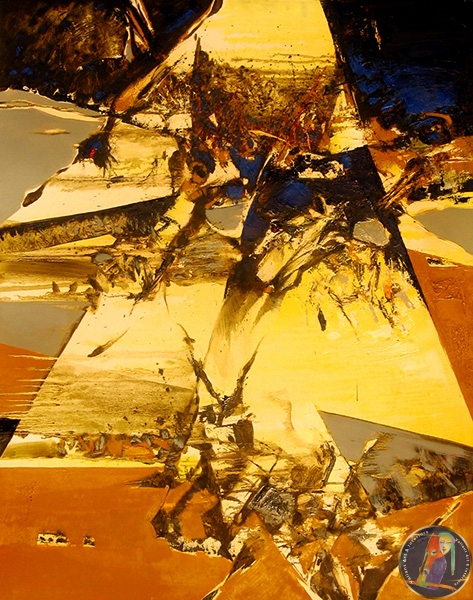
Composition 11 is a sweeping, large-format oil on canvas that serves as a bridge between Enkhtaivan Ochirbat’s formal academic training and his evolution into Contemporary Figurative Expressionism. Measuring 120 x 150cm, the work dominates the viewer’s field of vision, using the expansive horizontal space to echo the vastness of the Mongolian Steppe, a recurring motif in the artist’s subconscious.
Visual Analysis
The painting is characterized by a sophisticated interplay between structured abstraction and fluid, emotive brushwork. Created during a pivotal year when Ochirbat was exhibiting internationally in Bulgaria and Poland, the work reflects a departure from literal representation toward a more “Action”-oriented style.
Color Palette: The 2005 “Color” exhibition influence is evident here. The canvas is likely defined by earthy, tectonic tones—ochres, deep ambers, and slate greys—punctuated by sudden, vibrant shocks of primary color. These “color events” create a sense of internal light, suggesting a landscape that is felt rather than merely seen.
Texture and Form: Ochirbat utilizes thick, gestural applications of oil paint. The surface is a tactile map of the artist’s movements; heavy impasto sections suggest the rugged terrain of Bayangol or the Gobi, while thinner, translucent glazes allow underlying layers to “breathe,” creating a sense of atmospheric depth.
Compositional Rhythm: True to its title, the “Composition” is an exercise in balance. While the artist leans into his Abstract Modern style, there are ghostly vestiges of his Figurative roots. Indistinct shapes—perhaps suggestive of equine forms or nomadic dwellings—emerge from the haze of brushstrokes, only to dissolve back into the broader expressive field.
Context and Emotional Resonance
Painted while Ochirbat was balancing his role as an art teacher at the “Industry and Art” school, Composition 11 possesses a disciplined spontaneity. It captures the tension of a Mongolia in transition—moving from traditional heritage to a modern, globalized identity.
The work does not seek to depict a specific place, but rather the energy of a moment. The scale (120 x 150cm) allows the viewer to become lost in the rhythmic “Action” of the paint, mirroring the artist’s own exploration of space, heritage, and contemporary emotion. It stands as a testament to Ochirbat’s position as a leading voice in the post-1990s generation of Mongolian artists.