
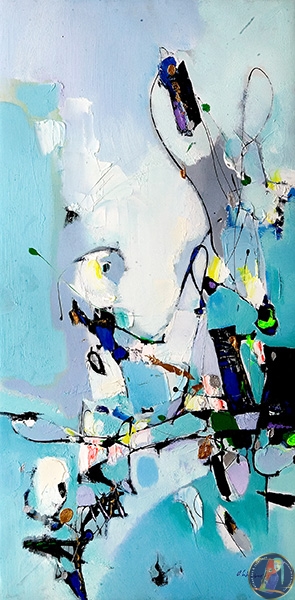
Composition 10, painted by Enkhtaivan Ochirbat in 2008, is a compelling example of Contemporary Figurative Expressionism captured on a horizontal oil-on-canvas format ($46 \times 92\text{cm}$). This piece serves as a bridge between the artist’s formal academic training in Ulaanbaatar and his evolving exploration of the Mongolian landscape through an abstract lens.
Visual Elements and Aesthetic
Color Palette: The painting is defined by a sophisticated use of earth tones—deep ochres, burnt sienna, and slate grays—interspersed with sudden, emotive bursts of color. Ochirbat often employs a high-contrast relationship between dark, brooding shadows and luminous highlights to create a sense of atmospheric depth.
Brushwork and Texture: True to his expressionist roots, the brushwork is energetic and tactile. There is a visible “action” in the paint application (likely influenced by his participation in the “Action” exhibitions earlier in the decade). The paint is layered with varying thicknesses, suggesting the rugged, weathered terrain of the Mongolian steppe.
Composition: The wide, panoramic aspect ratio ($1:2$ proportion) emphasizes the vastness of the horizon. Rather than a literal depiction of a landscape, the composition is broken into geometric and organic fragments. Figures or structural forms are often semi-abstracted, emerging from the background as if viewed through a haze of memory or shifting light.
Thematic Context
Created during his tenure as an art teacher at the “Industry and Art” school, Composition 10 reflects a period of professional stability and creative maturity.
The Fusion of Styles: The work sits at the intersection of Abstract Modernism and Figurative Landscape. It does not seek to document a specific location but rather to capture the essence of space. The “figurative” elements—perhaps the suggestion of horses or nomadic structures—are stripped of fine detail to focus on their silhouette and spiritual weight.
Cultural Resonance: Despite the modern technique, the soul of the painting is deeply rooted in the Mongolian identity. The tension between the rigid “Industry” and the fluid “Art” (echoing his workplace) is mirrored in the way structured lines interact with wild, sweeping color fields.