
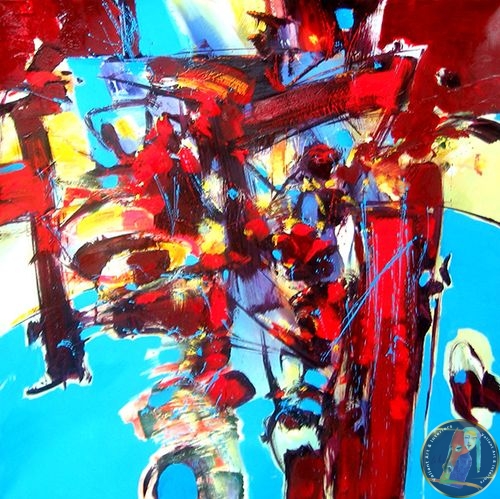
Composition 10 is a seminal work by Mongolian artist Enkhtaivan Ochirbat, created during a prolific period in 2005—the same year his work was showcased internationally in Bulgaria, Poland, and South Korea. This piece serves as a sophisticated intersection of his formal academic training and his evolution into Abstract Modernism and Expressionist Landscape.
Visual Breakdown
1. Geometric Harmony and Balance True to its title, the painting is an exercise in structural arrangement. Utilizing a square format (92 x 92 cm), Ochirbat creates a sense of equilibrium that mirrors the stability of the Mongolian steppe, yet vibrates with modern energy. The composition is likely structured around a central focal point or a series of intersecting planes that suggest depth without relying on traditional perspective.
2. Color Palette and Texture Given Ochirbat’s association with the “Color” exhibition of 2005, Composition 10 is characterized by a bold, emotive use of oil paint.
Tonal Quality: The artist often bridges the gap between the earthy, rugged tones of Ulaanbaatar’s surroundings and the vivid, synthetic colors of contemporary art.
Application: Expect thick, expressive brushwork or palette knife applications that provide a tactile, sculptural quality to the canvas. The “Expressionist” label suggests that color is used here to convey mood and the spiritual essence of a place rather than literal geography.
3. Style: The Synthesis of Figure and Land While the work leans toward abstraction, it remains rooted in Contemporary Figurative Landscape. In Composition 10, the “figures” may not be human, but rather the “anatomy” of the land—shadows, horizons, and rock formations distilled into rhythmic lines and shapes. There is a perceptible tension between the vastness of the Mongolian wilderness and the structured, urban influence of his life as an art teacher in the city.
Contextual Significance
Created seven years after his graduation from the Art Institute, this painting represents a mature artist who has moved beyond the “Art Studio” commercial phase into a deeper, pedagogical exploration of form.
Cultural Bridge: The work reflects a generation of Mongolian artists who came of age in the post-socialist era, blending traditional nomadic sensibilities with global avant-garde techniques.
Atmosphere: The painting likely evokes a sense of “Action”—a nod to his participation in the Action exhibition series (2002–2004)—suggesting movement, change, and the passage of time within a static, square frame.