

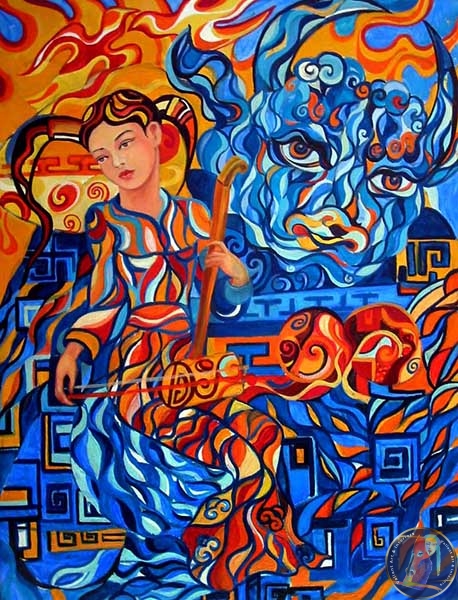
Compassion is an intimate yet powerful work that exemplifies Munkhtsetseg Bavuudorj’s signature fusion of figurative emotionality and abstract expressionism. Despite its modest dimensions, the painting vibrates with a profound spiritual energy, reflecting the artist’s Mongolian heritage and her deep exploration of the female psyche and human suffering.
Composition and Style
The piece leans heavily into Bavuudorj’s Expressionist leanings, prioritizing the “feeling” of the subject over anatomical precision. The central figure is rendered with fluid, almost ethereal lines that suggest a body in a state of deep introspection or prayer.
Color Palette: The 2005 work typically features a sophisticated interplay of earthy ochres, muted crimsons, and deep, shadowy indigos. These tones evoke a sense of ancient wisdom and organic warmth.
Brushwork: There is a tactile quality to the oil application. The artist uses layered, textured strokes to create a “skin” on the canvas that feels both vulnerable and resilient.
Symbolism: True to her style, the painting likely incorporates subtle, abstracted motifs—perhaps hints of traditional Mongolian iconography or biological forms—to represent the universal concept of “Compassion” as a protective, nurturing force.
Narrative Depth
In Compassion, Bavuudorj captures a moment of quiet intensity. The figure often appears to be cradling an unseen weight or dissolving into the background, suggesting that compassion is not just an outward act, but an internal transformation. The small scale (35 x 45 cm) forces the viewer to step closer, creating a private dialogue between the observer and the painted emotion.