
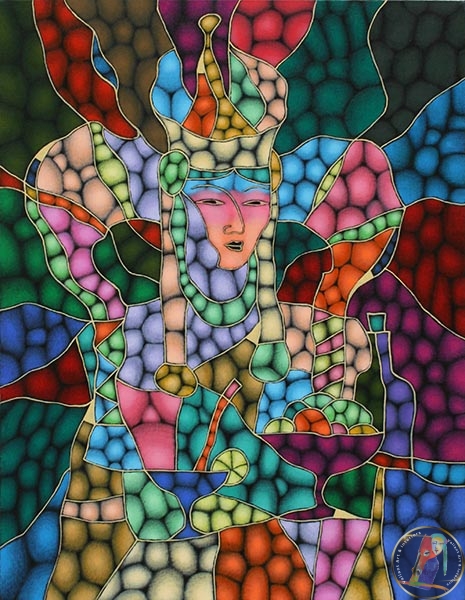
Colorful Queen is a striking fusion of contemporary portraiture and abstract expressionism. Created in 2009, this oil-on-canvas work reflects Janatkhan’s distinctive Mongolian heritage filtered through a sophisticated modern lens. The painting stands as a vibrant testament to the artist’s ability to balance regal poise with a chaotic, high-energy palette.
Composition and Color
The composition is dominated by a central figure—the “Queen”—whose presence is defined more by color and texture than by rigid anatomical lines. True to the Expressionist style, the artist prioritizes emotional resonance over literal representation:
The Palette: A kaleidoscopic array of pigments. Janatkhan utilizes bold primaries alongside earthy ochres and deep teals, likely a nod to the traditional aesthetic of Central Asian textiles and nomadic art.
Brushwork: The application of oil paint is thick and tactile, featuring energetic impasto strokes that suggest movement. The background and the figure’s garments bleed into one another, creating a sense that the subject is emerging from a whirlwind of historical or spiritual energy.
Style and Influence
Reflecting his education at the Institute of Fine Art and his extensive exhibition history across Europe and Asia, Janatkhan blends Eastern iconography with Western abstract techniques.
The Subject: The figure conveys a sense of timelessness. While the title suggests royalty, the “Queen” is rendered with a modern anonymity, making her a symbol of strength and cultural endurance rather than a specific historical personage.
Mood: There is a tension between the stillness of the portrait’s gaze and the turbulence of the surrounding colors. It feels both celebratory and introspective, capturing the “Modern / Contemporary” spirit that defines Janatkhan’s body of work.
Context
Produced nearly two decades after his first major international exhibitions in Pakistan and France, Colorful Queen represents a mature period for Janatkhan. The 90 x 70 cm scale provides an intimate yet commanding view of his subject, typical of his portraiture work that has traveled from Ulaanbaatar to the galleries of Amsterdam, Istanbul, and Hamburg.