
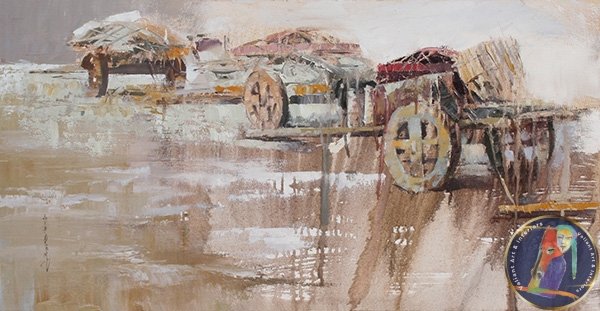
Coach

Ulziijavkhlan Adyabaatar , 2009 , Oil On Canvas

Painted on a wide, horizontal canvas, Coach is a realistic piece that captures the serene, sweeping atmosphere of the Mongolian countryside. Known for her “eco-art” style that emphasizes the deep, harmonious relationship between humans, animals, and nature, Adyabaatar focuses this composition on a traditional wooden horse-drawn coach or cart traveling across an expansive landscape.

The horizontal dimension of the canvas ($40 \times 80\text{ cm}$) naturally mirrors the vastness of the Mongolian steppe. The lower portion of the frame is dominated by rolling, open plains covered in subtle earth tones, soft greens, and golden grasses, suggesting either late summer or early autumn.

The focal point of the artwork—the coach—is rendered with a rich appreciation for traditional Mongolian rural life. Positioned on a faint, unpaved dirt path that cuts gently through the steppe, the wooden coach and its working horses are detailed with careful realism. The texture of the weathered wood, the simple structure of the cart, and the strong, quiet posture of the horses underscore a slower, deliberate pace of life.

Palette and Light

The color palette is rooted in the natural world:

  • Terrain: Muted ochres, soft umbers, and delicate greens establish a sense of immense, quiet space.

  • Sky: The upper half of the canvas features a vast, open sky filled with soft, atmospheric clouds. The light is diffused and gentle, casting soft shadows and bathing the entire scene in a calm, uniform glow.

Mood and Artistic Intent

True to Adyabaatar’s background from the semi-desert region of Dund Gobi, Coach evokes a profound sense of quietude, isolation, and timelessness. Rather than emphasizing hardship, the painting conveys a deep peace. The coach does not dominate the landscape; instead, it exists as a small, harmonious element within it, illustrating a way of life that moves in perfect rhythm with the natural world.
  • Ulziijavkhlan Adyabaatar
  • Dund Gobi, Mongolia
  • Figurative, Landscape, Nature, Portrait, Realism
  • Oil on canvas
  • ULZ83/010
  • 40 x 80cm15" x 31"
  • Valiant Art & Interiors

Add Your Comment

Mongolian Art Gallery © 2025. All Rights Reserved
Privacy Policy / Terms of Use

Painted on a wide, horizontal canvas, Coach is a realistic piece that captures the serene, sweeping atmosphere of the Mongolian countryside. Known for her “eco-art” style that emphasizes the deep, harmonious relationship between humans, animals, and nature, Adyabaatar focuses this composition on a traditional wooden horse-drawn coach or cart traveling across an expansive landscape.

The horizontal dimension of the canvas ($40 \times 80\text{ cm}$) naturally mirrors the vastness of the Mongolian steppe. The lower portion of the frame is dominated by rolling, open plains covered in subtle earth tones, soft greens, and golden grasses, suggesting either late summer or early autumn.

The focal point of the artwork—the coach—is rendered with a rich appreciation for traditional Mongolian rural life. Positioned on a faint, unpaved dirt path that cuts gently through the steppe, the wooden coach and its working horses are detailed with careful realism. The texture of the weathered wood, the simple structure of the cart, and the strong, quiet posture of the horses underscore a slower, deliberate pace of life.

Palette and Light

The color palette is rooted in the natural world:

  • Terrain: Muted ochres, soft umbers, and delicate greens establish a sense of immense, quiet space.

  • Sky: The upper half of the canvas features a vast, open sky filled with soft, atmospheric clouds. The light is diffused and gentle, casting soft shadows and bathing the entire scene in a calm, uniform glow.

Mood and Artistic Intent

True to Adyabaatar’s background from the semi-desert region of Dund Gobi, Coach evokes a profound sense of quietude, isolation, and timelessness. Rather than emphasizing hardship, the painting conveys a deep peace. The coach does not dominate the landscape; instead, it exists as a small, harmonious element within it, illustrating a way of life that moves in perfect rhythm with the natural world.