Chinggis Khan

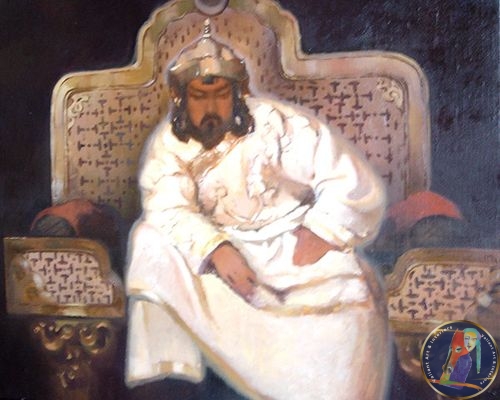
Narantsetseg Dorj , 2005 , Oil On Canvas

The 2005 portrait of Chinggis Khan by Narantsetseg Dorj is a masterful oil on canvas ($50 \times 59\text{cm}$) that serves as a bridge between traditional Mongol identity and the rigorous academic realism the artist honed in Moscow.

While the painting captures the historical magnitude of the Great Khan, it does so through a lens of intimate, psychological depth rather than purely mythic abstraction.

Visual Description

  • Subject and Composition: The painting features a powerful, close-up portrait of Chinggis Khan. Dorj utilizes a classical realist approach, focusing heavily on the structural integrity of the face. The composition is tight, creating an intense, immediate confrontation between the subject and the viewer. His gaze is typically rendered as piercing yet stoic—the “look of a strategist.”

  • Color Palette and Texture: True to her background in both Russian academicism and Mongolian landscape sensibilities, Dorj uses a rich, earthy palette. Deep ochres, burnt sienna, and leathery tans dominate the skin tones and garments, suggesting a life spent in the harsh elements of the Steppe. The oil medium is handled with visible but controlled brushwork, providing a tactile quality to the fur of his hat and the weathered texture of his skin.

  • Symbolism and Attire: The subject is depicted in traditional 13th-century Mongolian regalia. Particular attention is paid to the deeel (traditional robe) and the iconic Mongol hat. These elements are not just decorative; they are rendered with historical accuracy, reflecting the artist’s commitment to her heritage.


Artistic Context and Influence

Narantsetseg Dorj’s style is a unique synthesis of two distinct worlds:

  1. The Mongolian Foundation: Her early education in Ulaanbaatar gave her a deep spiritual and cultural connection to her subjects. This is evident in her choice of Chinggis Khan—a figure who represents the genesis of Mongolian statehood.

  2. The Moscow Influence: Her decade at the Surikov Fine Art Academy (1989–1998) is clearly visible in the painting’s Realism. The Surikov Academy is world-renowned for its emphasis on anatomy, light, and the “Grand Style” of portraiture. You can see this in how she captures the play of light across the Khan’s cheekbones and the furrow of his brow.

About the Artist: Narantsetseg Dorj

Born in 1961 in Ulaanbaatar, Dorj has established herself as a versatile freelance artist capable of moving seamlessly between landscapes and portraiture. Her work often acts as a preservation of Mongolian history. Having exhibited extensively in Moscow and Ulaanbaatar, her 2005 depiction of Chinggis Khan remains a definitive example of modern Mongolian realism—stripping away the “warlord” caricature to reveal a dignified, human leader.
  • Narantsetseg Dorj
  • Abstract, Expressionist
  • Oil On Canvas
  • NAR40/002
  • 50 x 59cm
  • Mongolian Art Gallery

Add Your Comment

Mongolian Art Gallery © 2025. All Rights Reserved
Privacy Policy / Terms of Use

The 2005 portrait of Chinggis Khan by Narantsetseg Dorj is a masterful oil on canvas ($50 \times 59\text{cm}$) that serves as a bridge between traditional Mongol identity and the rigorous academic realism the artist honed in Moscow.

While the painting captures the historical magnitude of the Great Khan, it does so through a lens of intimate, psychological depth rather than purely mythic abstraction.

Visual Description

  • Subject and Composition: The painting features a powerful, close-up portrait of Chinggis Khan. Dorj utilizes a classical realist approach, focusing heavily on the structural integrity of the face. The composition is tight, creating an intense, immediate confrontation between the subject and the viewer. His gaze is typically rendered as piercing yet stoic—the “look of a strategist.”

  • Color Palette and Texture: True to her background in both Russian academicism and Mongolian landscape sensibilities, Dorj uses a rich, earthy palette. Deep ochres, burnt sienna, and leathery tans dominate the skin tones and garments, suggesting a life spent in the harsh elements of the Steppe. The oil medium is handled with visible but controlled brushwork, providing a tactile quality to the fur of his hat and the weathered texture of his skin.

  • Symbolism and Attire: The subject is depicted in traditional 13th-century Mongolian regalia. Particular attention is paid to the deeel (traditional robe) and the iconic Mongol hat. These elements are not just decorative; they are rendered with historical accuracy, reflecting the artist’s commitment to her heritage.


Artistic Context and Influence

Narantsetseg Dorj’s style is a unique synthesis of two distinct worlds:

  1. The Mongolian Foundation: Her early education in Ulaanbaatar gave her a deep spiritual and cultural connection to her subjects. This is evident in her choice of Chinggis Khan—a figure who represents the genesis of Mongolian statehood.

  2. The Moscow Influence: Her decade at the Surikov Fine Art Academy (1989–1998) is clearly visible in the painting’s Realism. The Surikov Academy is world-renowned for its emphasis on anatomy, light, and the “Grand Style” of portraiture. You can see this in how she captures the play of light across the Khan’s cheekbones and the furrow of his brow.

About the Artist: Narantsetseg Dorj

Born in 1961 in Ulaanbaatar, Dorj has established herself as a versatile freelance artist capable of moving seamlessly between landscapes and portraiture. Her work often acts as a preservation of Mongolian history. Having exhibited extensively in Moscow and Ulaanbaatar, her 2005 depiction of Chinggis Khan remains a definitive example of modern Mongolian realism—stripping away the “warlord” caricature to reveal a dignified, human leader.