

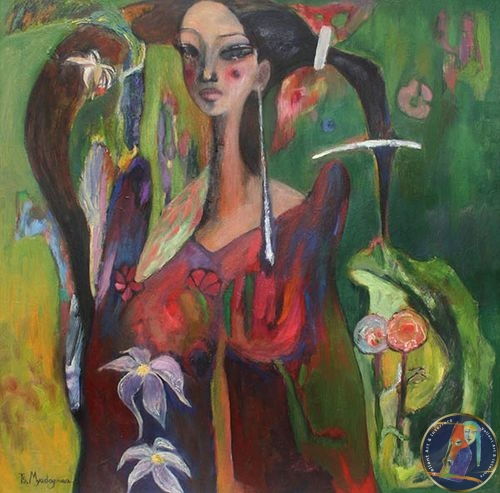
“Charged Woman” is a compelling oil-on-canvas work that stands as a definitive intersection of Mydagmaa Tserenpil’s minimalist leanings and her evocative use of abstract figurative elements. Rendered on a square $80.5 \text{ cm} \times 80.5 \text{ cm}$ format, the composition utilizes the symmetry of the canvas to heighten the psychological tension suggested by its title.
Visual Composition and Style
The painting features a refined balance between form and void, characteristic of Tserenpil’s background in minimalist figurative landscapes. The central figure—the “Charged Woman”—is often rendered with a deliberate economy of line, focusing on posture and the energetic “charge” rather than meticulous anatomical detail.
Color Palette: The 2009 period of Tserenpil’s work often employed a sophisticated interplay of earthy, grounded tones contrasted with sudden, vibrant accents that represent the internal energy or “charge” of the subject.
Texture: As an oil painting, the surface likely features a mix of smooth, glazed areas and localized impasto, where the paint is applied more thickly to suggest movement or emotional density.
Spatial Dynamics: True to her style, the figure is likely situated within a deconstructed space. The “landscape” elements are abstracted into planes of color or subtle gradients, creating an atmospheric depth that pushes the figure toward the viewer.
Artistic Context and Significance
Produced when the artist was twenty-five, this piece represents a vital era in Tserenpil’s career, shortly before her international exposure at the Carrousel Du Louvre in 2010.
Cultural Connection: While the style is contemporary and abstract, the emotional resonance often mirrors the expansive, quiet intensity of the Mongolian landscape of her birth (Bayankhongor).
Thematic Depth: The “Charged” nature of the woman can be interpreted as a study of potential energy—the moment before action or the weight of internal thought. It avoids traditional portraiture in favor of capturing an existential state.