
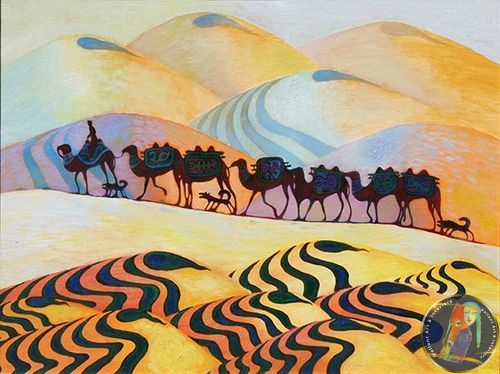
In Caravan, Tsegmid Tserennadmid utilizes his signature blend of Modern Expressionism and Abstract Landscape to capture a quintessentially Mongolian theme. The painting depicts a traditional caravan moving through a vast, ethereal space, rendered not with photographic realism, but through emotive, textured brushwork that evokes the spiritual and physical endurance of nomadic life.
Composition and Style
The 53 x 73 cm canvas is dominated by a sweeping, horizontal energy that mirrors the vastness of the Mongolian steppe. Tserennadmid rejects rigid outlines in favor of fluid, overlapping shapes. The “Caravan” itself—likely a train of camels or horses—is abstracted into a rhythmic sequence of forms that seem to emerge from and recede back into the atmosphere of the land.
Expressionist Texture: The oil paint is applied with visible, energetic strokes, creating a sense of constant motion. This texture suggests the harsh winds and shifting sands of the Gobi or the high plains.
Color Palette: The artist typically employs a sophisticated palette of earth tones—ochres, deep browns, and siennas—punctuated by flashes of “Contemporary” vibrancy, such as cool blues or sudden streaks of white, representing the play of light against a rugged horizon.
Atmospheric Perspective
The painting avoids a traditional vanishing point. Instead, the “Landscape” is felt through the weight of the colors. The lower third of the canvas carries the heavy, grounded pigment of the earth, while the upper portion lightens into an expansive, abstract sky. The subjects (the caravan) act as the connective tissue between the terrestrial and the celestial, symbolizing the nomadic harmony with nature.