Camels And Dove

Tsegmid Tserennadmid , 2008 , Oil On Canvas

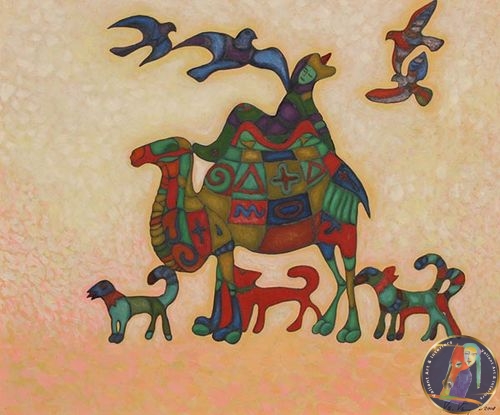
In Camels And Dove, Tsegmid Tserennadmid merges his deep Mongolian roots with a sophisticated Contemporary Expressionist style. The painting is a vibrant exploration of the relationship between the rugged wildlife of the Central Asian steppe and the ethereal presence of peace. While the subject matter is grounded in the Mongolian landscape, the execution leans into Abstraction, prioritizing emotional resonance and texture over literal representation.

Composition and Subject Matter

The 60 x 72 cm canvas is dominated by the powerful, rhythmic silhouettes of camels. Tserennadmid utilizes the “Landscape” aspect of his background not to paint a realistic horizon, but to evoke the vastness of the Gobi.

  • The Camels: The camels are rendered with bold, sweeping brushstrokes that emphasize their humps and sturdy forms. They appear almost architectural, acting as the grounding pillars of the composition. Their forms are slightly distorted, leaning into Modernism, which conveys a sense of ancient endurance.

  • The Dove: Contrasting the heavy, terrestrial weight of the camels is the delicate figure of a dove. Its presence introduces a spiritual or symbolic layer—representing peace, freedom, or a messenger of the sky. The dove provides a focal point that disrupts the monochromatic rhythm of the animals, creating a narrative tension between the “earthbound” and the “airborne.”

Style and Technique

Tserennadmid’s experience as both a teacher and a director of prestigious art institutions is evident in his masterful handling of the Oil on canvas medium.

  • Expressionist Color Palette: The artist likely employs a palette of earthy ochres, deep ambers, and sienna to reflect the Mongolian terrain, punctuated by sharp, expressive highlights. The colors are applied with high energy, typical of the Expressionist style, where the artist’s “inner world” dictates the vibrancy of the scene.

  • Texture and Mark-Making: The surface is rich with texture. Thick impasto strokes define the camels’ wooly coats, while thinner, more fluid glazes may be used for the surrounding atmosphere. This play of light and shadow gives the work a dynamic, “living” quality.

  • Abstract Elements: While the figures are recognizable, the boundaries between the subjects and the background are blurred. This Abstract approach invites the viewer to see the painting as a series of movements and forces rather than just a static image of animals.

Cultural Context

Having lived and taught in Ulaanbaatar, Tserennadmid captures the soul of the nomadic heritage. The painting reflects a bridge between the traditional Mongolian reverence for nature and the global language of Modern Art. The work feels both timeless—evoking the “Kingdom of the Horse” and the ancient Silk Road—and distinctly contemporary in its bold, experimental execution.
  • Tsegmid Tserennadmid
  • Abstract, Modern/Contemporary
  • Oil On Canvas
  • TSG48/034
  • 60 x 72cm
  • Mongolian Art Gallery

Add Your Comment

Mongolian Art Gallery © 2025. All Rights Reserved
Privacy Policy / Terms of Use

In Camels And Dove, Tsegmid Tserennadmid merges his deep Mongolian roots with a sophisticated Contemporary Expressionist style. The painting is a vibrant exploration of the relationship between the rugged wildlife of the Central Asian steppe and the ethereal presence of peace. While the subject matter is grounded in the Mongolian landscape, the execution leans into Abstraction, prioritizing emotional resonance and texture over literal representation.

Composition and Subject Matter

The 60 x 72 cm canvas is dominated by the powerful, rhythmic silhouettes of camels. Tserennadmid utilizes the “Landscape” aspect of his background not to paint a realistic horizon, but to evoke the vastness of the Gobi.

  • The Camels: The camels are rendered with bold, sweeping brushstrokes that emphasize their humps and sturdy forms. They appear almost architectural, acting as the grounding pillars of the composition. Their forms are slightly distorted, leaning into Modernism, which conveys a sense of ancient endurance.

  • The Dove: Contrasting the heavy, terrestrial weight of the camels is the delicate figure of a dove. Its presence introduces a spiritual or symbolic layer—representing peace, freedom, or a messenger of the sky. The dove provides a focal point that disrupts the monochromatic rhythm of the animals, creating a narrative tension between the “earthbound” and the “airborne.”

Style and Technique

Tserennadmid’s experience as both a teacher and a director of prestigious art institutions is evident in his masterful handling of the Oil on canvas medium.

  • Expressionist Color Palette: The artist likely employs a palette of earthy ochres, deep ambers, and sienna to reflect the Mongolian terrain, punctuated by sharp, expressive highlights. The colors are applied with high energy, typical of the Expressionist style, where the artist’s “inner world” dictates the vibrancy of the scene.

  • Texture and Mark-Making: The surface is rich with texture. Thick impasto strokes define the camels’ wooly coats, while thinner, more fluid glazes may be used for the surrounding atmosphere. This play of light and shadow gives the work a dynamic, “living” quality.

  • Abstract Elements: While the figures are recognizable, the boundaries between the subjects and the background are blurred. This Abstract approach invites the viewer to see the painting as a series of movements and forces rather than just a static image of animals.

Cultural Context

Having lived and taught in Ulaanbaatar, Tserennadmid captures the soul of the nomadic heritage. The painting reflects a bridge between the traditional Mongolian reverence for nature and the global language of Modern Art. The work feels both timeless—evoking the “Kingdom of the Horse” and the ancient Silk Road—and distinctly contemporary in its bold, experimental execution.