Camels

Khurelbaatar Choindon , 2006 , Oil On Canvas

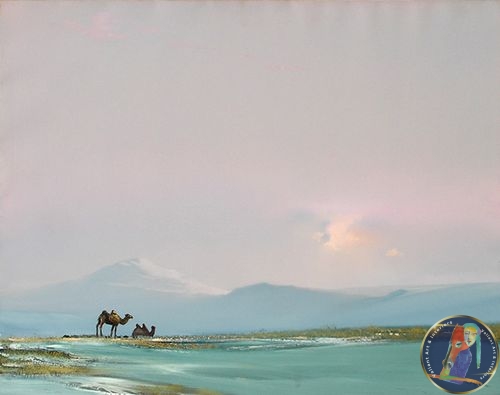
In this 2006 oil on canvas, Khurelbaatar Choindon leverages his mastery of Photorealism and his deep-rooted connection to the Mongolian landscape to create a work that is as much a cultural document as it is a piece of fine art. Measuring $61 \times 72$ cm, the painting offers an intimate yet expansive view of Mongolia’s most iconic inhabitants.


Visual Composition and Style

The painting is characterized by a high degree of Realism, reflecting Choindon’s rigorous academic training at the Repin Academy of Fine Art. The composition focuses on a group of Bactrian camels, rendered with such anatomical precision that the viewer can almost feel the coarse texture of their winter wool and the heavy weight of their humps.

  • Texture and Detail: Choindon utilizes fine brushwork to capture the nuances of the camels’ fur, transitioning from thick, matted patches to softer undercoats.

  • Lighting: The light source is naturalistic, suggesting the clear, sharp atmosphere of the Mongolian steppe. The interplay of light and shadow defines the muscular structure of the animals and grounds them firmly within the environment.

  • Color Palette: The artist employs a sophisticated earthy palette. Rich ochres, deep browns, and muted tans dominate the subjects, while the background landscape consists of subtle gradients of sand, stone, and the pale, vast Mongolian sky.

Landscape and Atmosphere

True to the Landscape and Nature styles associated with his work, Choindon does not merely paint animals; he paints an ecosystem. The setting is likely the Gobi or the semi-desert steppes, where the horizon line is placed to emphasize the immense scale of the sky.

The atmosphere is one of stillness and resilience. There is no frantic movement; instead, the “Figurative” arrangement of the camels suggests a moment of rest or steady progression through a harsh environment. This stillness reflects the “eternal” quality of the Mongolian countryside that Choindon frequently explores.


Artistic Context

Created during his tenure as the Vice Chairman of the Union of Mongolian Artists (UMA), Camels represents Choindon at the height of his technical powers.

  • Mongolian Identity: The camel is a symbol of endurance and nomadic heritage. By choosing this subject, Choindon connects his St. Petersburg-refined technique with his Mongolian soul.

  • The Repin Influence: The influence of the Repin Academy is evident in the painting’s “Academic Realism”—a style that prioritizes formal excellence, spatial depth, and a reverent approach to the physical world.

Summary

Camels is a testament to Khurelbaatar Choindon’s ability to bridge the gap between traditional Mongolian subject matter and Western classical oil painting techniques. It stands as a quiet, powerful tribute to the natural beauty and the rugged spirit of his homeland.
  • Khurelbaatar Choindon
  • Figurative, Realism
  • Oil On Canvas
  • KBR31/041
  • 61 x 72cm
  • Mongolian Art Gallery

Add Your Comment

Mongolian Art Gallery © 2025. All Rights Reserved
Privacy Policy / Terms of Use

In this 2006 oil on canvas, Khurelbaatar Choindon leverages his mastery of Photorealism and his deep-rooted connection to the Mongolian landscape to create a work that is as much a cultural document as it is a piece of fine art. Measuring $61 \times 72$ cm, the painting offers an intimate yet expansive view of Mongolia’s most iconic inhabitants.


Visual Composition and Style

The painting is characterized by a high degree of Realism, reflecting Choindon’s rigorous academic training at the Repin Academy of Fine Art. The composition focuses on a group of Bactrian camels, rendered with such anatomical precision that the viewer can almost feel the coarse texture of their winter wool and the heavy weight of their humps.

  • Texture and Detail: Choindon utilizes fine brushwork to capture the nuances of the camels’ fur, transitioning from thick, matted patches to softer undercoats.

  • Lighting: The light source is naturalistic, suggesting the clear, sharp atmosphere of the Mongolian steppe. The interplay of light and shadow defines the muscular structure of the animals and grounds them firmly within the environment.

  • Color Palette: The artist employs a sophisticated earthy palette. Rich ochres, deep browns, and muted tans dominate the subjects, while the background landscape consists of subtle gradients of sand, stone, and the pale, vast Mongolian sky.

Landscape and Atmosphere

True to the Landscape and Nature styles associated with his work, Choindon does not merely paint animals; he paints an ecosystem. The setting is likely the Gobi or the semi-desert steppes, where the horizon line is placed to emphasize the immense scale of the sky.

The atmosphere is one of stillness and resilience. There is no frantic movement; instead, the “Figurative” arrangement of the camels suggests a moment of rest or steady progression through a harsh environment. This stillness reflects the “eternal” quality of the Mongolian countryside that Choindon frequently explores.


Artistic Context

Created during his tenure as the Vice Chairman of the Union of Mongolian Artists (UMA), Camels represents Choindon at the height of his technical powers.

  • Mongolian Identity: The camel is a symbol of endurance and nomadic heritage. By choosing this subject, Choindon connects his St. Petersburg-refined technique with his Mongolian soul.

  • The Repin Influence: The influence of the Repin Academy is evident in the painting’s “Academic Realism”—a style that prioritizes formal excellence, spatial depth, and a reverent approach to the physical world.

Summary

Camels is a testament to Khurelbaatar Choindon’s ability to bridge the gap between traditional Mongolian subject matter and Western classical oil painting techniques. It stands as a quiet, powerful tribute to the natural beauty and the rugged spirit of his homeland.