
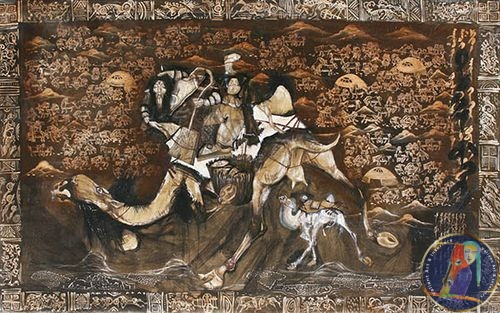
Camels

Munkhbat Naranpeljee , 2010 , Oil On Canvas

Camels is a masterful oil painting that captures the rugged essence and stoic beauty of the Central Asian landscape. Spanning nearly two meters in width, the large-scale canvas offers an immersive experience, placing the viewer directly into the sweeping horizons and rhythmic movement of a nomadic caravan. Created in 2010, the work serves as a testament to Naranpeljee’s ability to blend traditional Mongolian subject matter with a refined, contemporary technical execution.

Composition and Subject Matter

The painting depicts a group of Bactrian camels—the iconic two-humped symbols of the Gobi Desert—moving across the terrain. Naranpeljee utilizes the horizontal expanse of the 176 cm canvas to emphasize the grandeur of the environment. The camels are not merely subjects; they are integrated into the rhythm of the landscape, their humps mimicking the undulating hills and dunes of the background.

The arrangement of the herd creates a sense of deliberate motion. Some camels are captured in profile, showcasing their powerful anatomy and thick, textured coats, while others are positioned at angles that suggest the depth and vastness of the space they inhabit.

Technique and Color Palette

Naranpeljee’s use of oil paint is both tactile and atmospheric. The texture of the camel hair is rendered with a meticulous yet fluid brushwork that conveys the coarseness of their fur against the biting winds of the steppe.

The color palette is a sophisticated study of earth tones:

  • Ochres and Umbers: Dominating the bodies of the camels and the immediate foreground.

  • Muted Grays and Blues: Used in the sky and distant ridges to create atmospheric perspective.

  • Subtle Highlights: Soft light filters across the scene, catching the tops of the camels’ humps and the ridges of the earth, providing a sculptural quality to the forms.

Cultural Significance and Legacy

This piece is a quintessential example of Naranpeljee’s “Art of the Nomad” philosophy. By focusing on the camel—an animal essential to survival and culture in Mongolia—the artist bridges the gap between ancient heritage and modern fine art.

The painting’s international importance is underscored by its exhibition history in 2010, traveling from the prestigious Grimaldi Forum in Monaco to the Carrousel du Louvre in Paris. Its presence at the International Equestrian Festival further highlights the work’s connection to nomadic traditions and the deep-seated relationship between the people of the steppe and their livestock.

  • Munkhbat Naranpeljee
  • Calligraphy, Figurative
  • Oil On Canvas
  • MBT/008
  • 109 x 176cm
  • Mongolian Art Gallery

Add Your Comment

Mongolian Art Gallery © 2025. All Rights Reserved
Privacy Policy / Terms of Use

Camels is a masterful oil painting that captures the rugged essence and stoic beauty of the Central Asian landscape. Spanning nearly two meters in width, the large-scale canvas offers an immersive experience, placing the viewer directly into the sweeping horizons and rhythmic movement of a nomadic caravan. Created in 2010, the work serves as a testament to Naranpeljee’s ability to blend traditional Mongolian subject matter with a refined, contemporary technical execution.

Composition and Subject Matter

The painting depicts a group of Bactrian camels—the iconic two-humped symbols of the Gobi Desert—moving across the terrain. Naranpeljee utilizes the horizontal expanse of the 176 cm canvas to emphasize the grandeur of the environment. The camels are not merely subjects; they are integrated into the rhythm of the landscape, their humps mimicking the undulating hills and dunes of the background.

The arrangement of the herd creates a sense of deliberate motion. Some camels are captured in profile, showcasing their powerful anatomy and thick, textured coats, while others are positioned at angles that suggest the depth and vastness of the space they inhabit.

Technique and Color Palette

Naranpeljee’s use of oil paint is both tactile and atmospheric. The texture of the camel hair is rendered with a meticulous yet fluid brushwork that conveys the coarseness of their fur against the biting winds of the steppe.

The color palette is a sophisticated study of earth tones:

  • Ochres and Umbers: Dominating the bodies of the camels and the immediate foreground.

  • Muted Grays and Blues: Used in the sky and distant ridges to create atmospheric perspective.

  • Subtle Highlights: Soft light filters across the scene, catching the tops of the camels’ humps and the ridges of the earth, providing a sculptural quality to the forms.

Cultural Significance and Legacy

This piece is a quintessential example of Naranpeljee’s “Art of the Nomad” philosophy. By focusing on the camel—an animal essential to survival and culture in Mongolia—the artist bridges the gap between ancient heritage and modern fine art.

The painting’s international importance is underscored by its exhibition history in 2010, traveling from the prestigious Grimaldi Forum in Monaco to the Carrousel du Louvre in Paris. Its presence at the International Equestrian Festival further highlights the work’s connection to nomadic traditions and the deep-seated relationship between the people of the steppe and their livestock.