
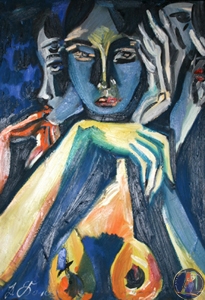
Breast is a compelling exploration of form and emotion by Mongolian contemporary artist Ganbold (Bono) Dorjderem. Created within his signature fusion of Abstract and Figurative styles, the work reflects the artist’s evolution from his early exhibitions in Beijing and Shanghai toward the philosophical “Aphorism” and “Freedom” periods of the mid-2000s.
Visual Composition
The painting utilizes the verticality of its 90 x 60 cm canvas to present a monumental perspective of the female form. Rather than a traditional anatomical study, Ganbold employs a Modern Contemporary lens that deconstructs the subject into a series of fluid, rhythmic contours.
Form and Silhouette: The central focus—the breast—is rendered not as a static object but as a landscape of soft curves and sharp intersections. The figurative elements bleed into abstraction, suggesting the weight and gravity of the body while maintaining a sense of ethereal lightness.
Brushwork and Texture: Using the rich viscosity of Oil on Canvas, Ganbold applies paint with a sophisticated balance of impasto and glazed layers. This creates a tactile surface that mimics the warmth and vulnerability of skin, contrasting with more aggressive, expressive strokes that define the surrounding negative space.
Color Palette: The palette likely draws from the tonal shifts characteristic of Ganbold’s mid-2000s work, utilizing earthy ochres, deep ambers, and subtle fleshtones. These are often punctuated by cooler, atmospheric shadows that give the composition a three-dimensional, sculptural quality.
Style and Influence
Reflecting the artist’s roots in Ulaanbaatar and his subsequent international exposure, the piece bridges the gap between traditional Mongolian aesthetics and global modernism. The Nude subject matter is handled with a reverence for the “Aphorism in Art” philosophy, where the physical form serves as a visual shorthand for deeper existential themes—nurture, identity, and the liberation of the human spirit.
“In Breast, Ganbold strips away the superfluous, leaving the viewer with a singular, powerful meditation on the biological and spiritual essence of femininity.”
Historical Context
Produced during a pivotal era for the artist (surrounding the 2006 “Great Mongolia 800” and his 2007 solo exhibitions), this work represents Ganbold’s mastery of the figurative-abstract balance. It stands as a testament to his ability to transform a classical subject into a modern, emotive experience.