
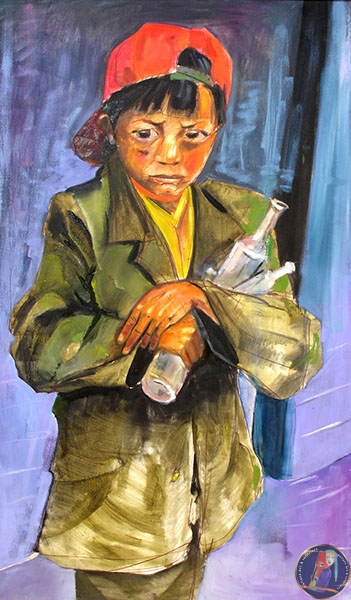
Standing at a vertical 160 cm, Boy is a life-sized figurative work that commands a physical presence similar to that of a standing person. The narrow, elongated canvas heightens the sense of the subject’s isolation and upright posture. While the painting is rooted in Figurative and Portrait styles, Tsulbaatar’s execution leans heavily into Modern Contemporary sensibilities, where the subject and the space around him feel equally prioritized.
Subject Matter and Mood
The painting depicts a young boy, rendered with a blend of anatomical precision and expressive abstraction. Typical of Tsulbaatar’s work from this period, there is a distinct emotional weight to the figure—a hallmark of his “Seeking the Real Feel” era. The boy’s expression is often one of quiet contemplation or stoicism, reflecting the artist’s focus on the inner psychological state rather than a mere physical likeness.
The scale of the boy within the frame suggests a sense of vulnerability. By placing a small figure on a large canvas, the artist emphasizes the “emptiness” of the surrounding environment, which is often treated with Abstract textures and muted, earthy tones—perhaps a subtle nod to the vast landscapes and light of the artist’s Mongolian heritage.
Technique and Style
The Brushwork: The oil application is likely a mix of smooth, blended skin tones and more aggressive, textured palette knife work or broad brushstrokes in the background. This contrast allows the figure to “emerge” from an abstract field of color.
Color Palette: Given Tsulbaatar’s contemporary approach, the palette usually favors a sophisticated range of neutrals—greys, deep ochres, and cool blues—punctuated by sharper, more vibrant tones to highlight the boy’s features or clothing.
Modernity vs. Tradition: While the subject (a portrait of a child) is a classical theme, the 2007 execution displays the artist’s post-University evolution. It moves away from academic realism toward a more subjective, atmospheric “Modern Painting” style that was being celebrated in Ulaanbaatar during his early career exhibitions.
Contextual Significance
Created just two years after his graduation from the Fine Art University, Boy represents a pivotal moment in Tsulbaatar’s career. This work was produced during a highly active period (2006–2007) where the artist was featured in several major exhibitions, including “New Art” and “Modern Painting.” It serves as a bridge between his formal training and his emergence as a leading voice in the contemporary Mongolian art scene.