

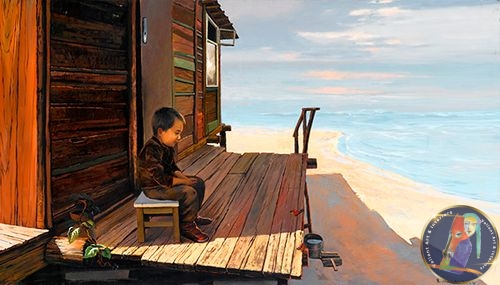
“Boy” (2006) is a poignant example of contemporary Mongolian realism, masterfully executed by Mergen Baidy. Painted in oil on a horizontal 80 x 140cm canvas, the work bridges the gap between traditional nomadic life and the introspective nature of figurative portraiture.
Visual Composition and Style
The painting is a wide-format figurative portrait set against the expansive backdrop of the Mongolian landscape. Baidy utilizes his signature Realist style to capture a moment of quietude, emphasizing the deep connection between the subject and the environment.
The Subject: The “Boy” serves as the central focal point. Baidy renders the child’s features with meticulous detail, capturing the weathered texture of skin exposed to the high-altitude sun and the sharp, observant gaze typical of youth raised in the steppe.
The Palette: The artist employs a rich, earthy palette dominated by ochres, siennas, and deep browns, contrasted against the vast, often ethereal blues and muted greens of the Mongolian horizon. The use of oil allows for a soft diffusion of light that gives the skin a luminous, lifelike quality.
Perspective: The 140cm width of the canvas allows for a panoramic view. This choice of scale suggests that the boy is not just an isolated figure, but an integral part of the “Nature” and “Landscape” categories for which Baidy is known.
Context and Atmosphere
Created in 2006, this work reflects the artist’s roots in Dundgobi. The painting evokes a sense of stillness and resilience. There is a “monumental” feel to the composition; despite the subject being a child, the weight of the heritage and the gravity of the landscape lend him a mature, grounded presence.
Realism vs. Emotion: While the technique is strictly realist, the emotional output is one of understated pride and solitude.
Cultural Significance: As seen in Baidy’s later participation in the International Equestrian Festival, his work often celebrates the nomadic spirit. In “Boy,” this is felt through the suggestion of a life lived outdoors, where the boundary between the human figure and the natural world is nearly seamless.