
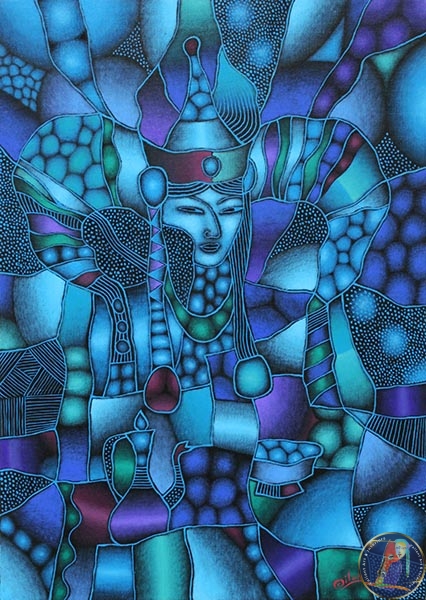
Blue Queen is a compelling synthesis of Mongolian heritage and modern expressionism. Painted in 2009, this large-scale oil portrait captures a regal female figure that feels simultaneously ancient and avant-garde. Janatkhan utilizes his signature blend of abstract textures and figurative precision to create a work that transcends traditional portraiture.
Visual Composition & Style
The painting is dominated by a rich, evocative palette of cerulean, cobalt, and deep indigo, which provides the piece with its namesake atmosphere. Janatkhan employs a bold, expressionist technique where the background and the subject’s garments often bleed into one another through heavy, textured brushstrokes.
The Subject: The “Queen” is depicted with a stoic, serene countenance. Her features are rendered with a delicate clarity that contrasts against the more chaotic, abstract environment surrounding her. Her gaze is direct yet enigmatic, suggesting a position of power and quiet introspection.
Symbolism & Attire: She is adorned in stylized traditional Mongolian finery. The artist reimagines the deel (traditional robe) and elaborate headdress through a contemporary lens, using thick impasto and sweeping lines to suggest luxury and cultural weight without relying on literal detail.
Color Theory: While blues dominate, Janatkhan introduces subtle highlights of gold, silver, or muted earth tones to catch the light, mimicking the sheen of silk or the glint of nomadic jewelry. This contrast ensures the figure remains the undisputed focal point of the 100 x 70 cm canvas.
Artistic Context
Reflecting Janatkhan’s education at the Institute of Fine Art and his extensive exhibition history across Europe and Asia, Blue Queen serves as a bridge between East and West. The influence of his travels—from the galleries of Paris to the landscapes of Kazakhstan—is evident in the way he deconstructs form.
The painting is not merely a depiction of a person, but an exploration of identity and memory. It sits at the intersection of his “Portrait” and “Abstract” styles, where the physical likeness of the Queen is secondary to the emotional and cultural “vibe” she projected during the post-Soviet Mongolian art renaissance.